In all facets of art — appreciating, studying, doing — we learn how important it is for us to “find ourselves”, to explore our personal preferences and do what we love. In the pursuit of pleasure and happiness, we tend to focus on the “likes” more than the “dislikes”, and there’s nothing wrong with that, really.
But why do we dislike certain things?
Each morning when I sit down at my computer, I’m greeted with a “wallpaper image” — a photo of some natural feature or bustling city. It could be anything. There’s also the question “Like what you see?” This morning was one of those days when, no, I didn’t like anything I was presented.
First was a scene from bustling, busy Los Angeles. I clicked past it. I don’t even remember what the second scene was, but I clicked past it, too. Third was an architectural scene. Nope, not for me! Finally the computer gave up, decided I was impossible to please, and gave me a generic wallpaper, which I was quite happy with.
The experience sparked my curiosity, though. Why do I dislike certain things when it comes to visual images? Do I make choices based on color? Subject? Composition? My mood of the day? The responses I give to my computer’s attempts to generate suitable wallpapers are probably based on all of these factors and more.
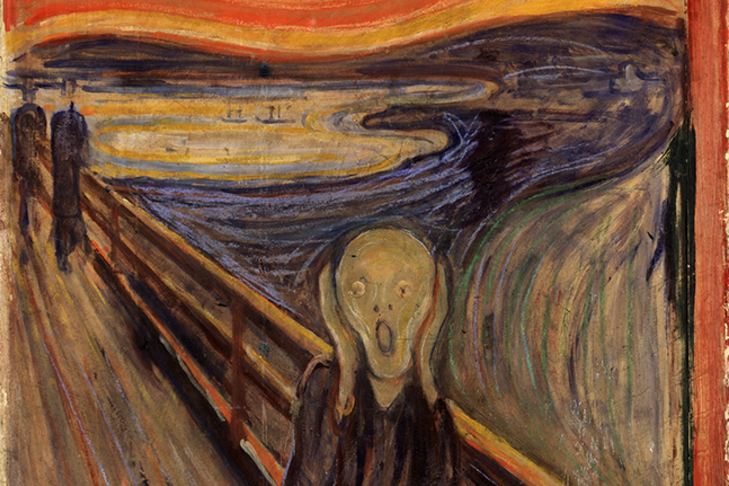
Next, I took the question to a more “artistic” level, thinking about famous works of art that, for whatever reason, I just don’t like. The first piece that came to mind — and I apologize if my choice here offends or disappoints anyone — was “The Scream”. You know the painting, you’ve seen it again and again. It’s one of the most “parodied” artworks of our time.
Here, is an “animated” version, just to add to the “creep” factor:
There is so much to be said about this painting — which, you may already know — is not one single painting, but a concept the artist – Edvard Munch — painted repeatedly over a period of seventeen years.
The painting, in all its variations, was based on personal experience, and Munch wrote a short poem to accompany the art:
I was walking along the road with two Friends / the Sun was setting – The Sky turned a bloody red / And I felt a whiff of Melancholy – I stood / Still, deathly tired – over the blue-black / Fjord and City hung Blood and Tongues of Fire / My Friends walked on – I remained behind / – shivering with Anxiety – I felt the great Scream in Nature – EM.
Here, it’s important that we consider the value of “authenticity” in art, and “The Scream” — more correctly titled “Der Schrei de Natur” (The Scream of Nature) — is a study in authenticity. It is considered a masterpiece of modern art, a tribute to troubling times, a work of art defining an age of anxiety and uncertainty. It’s been called “The image that launched a thousand therapists”.
You can read more — if you want — about this painting and its varying versions at the links below:
The Scream – 1893 – by Edvard Munch
Definitely the painting has meaning, in terms of both the artist’s personal experience and in the context of its time. It is expressive. It is creative. It can be studied in depth, with more and more thoughts coming forth. Maybe it’s a bit like an artistic Rorschach test — and if you’re curious, you can views the Rorschach Inkblot cards online: Rorschach Inkblot Test
But let’s return to The Scream. Why do I have such an intense dislike for this painting? I guess it’s because, in so many ways, I do find it frightening. I don’t want to think about fearful things. The image, for me, also suggests mental illness, perhaps a form of dementia. I think here about my older sister and her paranoia — her persistent beliefs that people are hanging from her ceiling to spy on her, that people are hiding under her bed, that staff personnel at the care facility are trying to smother her, kidnap her, or put her on a boat to be trafficked somewhere in the world. What a horrible, horrible world to live in.
Yes, Munch did an excellent job of capturing all of these fearful, frightening, terrifying emotions. Yes, The Scream of Nature is indeed a masterpiece, a work of art in the truest sense. But, it’s not for me. And that’s all right.
When it comes to art, we don’t have to like everything we see. There will be paintings that bring us great joy and happiness, paintings that make us gasp from their sheer beauty. There will be paintings that are meaningful because of their emotional narrative, paintings that have an important place in art history, paintings that simply “resonate” with us in one way or another.
And there will be those paintings that make us turn away. I can “appreciate” Munch’s painting for all that it is, but it’s just not for me.
UPDATE: When I wrote this article, I said I hoped I wasn’t offending or disappointing anyone. I knew that there wre others out there who like — even love — Edvard Munch’s famous painting. One of those is Ruth, from Ruth Blogs Here. In fact, she once created her own version of the painting. So, check out her blog post and enjoy!
A-Z Challenge: S is for Simplified and Stylized
What are your thoughts and feelings about “The Scream”?
Do you have a particular painting that you dislike?
WHAT, IF ANYTHING, CAN WE LEARN FROM THINGS WE DISLIKE?
 Artistcoveries
Art is and can only be subjective. One man’s meat is another man’s poison so to speak.
This is both wonderful and dangerous. Wonderful that we are free to like what we like. Dangerous when censorship is ignored completely.
I can take or leave The Scream. My own art is hopefully unpretentious and can be summed up in the word: Design.
Thanks for sharing your perspective.
LikeLiked by 1 person
A saying I heard often as a child is “There’s no accounting for taste”, which means, as you’ve said, that art (and many other things) are highly subjective. We like what we like for whatever reasons, and we dislike what we dislike for whatever reasons, and there really is no “accounting” for it. Still, it’s fun for me to explore the idea a bit. I usually focus on “likes” in art, sharing paintings that are favorites, such as The Child’s Bath, by Mary Cassatt. For this post, I thought it wold be fun to take the opposite approach and when I thought of “dislikes”, The Scream of Nature came immediately to mind. The art world is filled with controversy over what is or isn’t “art”, and censorship is a difficult issue. It’s a fascinating topic that can be discussed ad infinitum without ever coming up with definitive answers. And that’s what makes art so wonderful, I think. Thank goodness we don’t all agree on what’s “good” and what’s “not good”. Thank goodness we do have unique, subjective, personal views on art. Thanks so much for sharing your thoughts!
LikeLike
Thanks – we mostly concur. 😎
LikeLiked by 1 person
I’m one of the weirdos who love it! I used to have it as a huge poster on my bedroom wall when I was younger, it’s always resonated with me, but then I’ve had a lot of mental health issues so maybe that’s why? 🙂
LikeLiked by 1 person
Interesting! It’s fascinating to see how people respond differently to things. Personal experience is likely a part of it. I think colors are important, too, at some deep emotional level. Mostly there’s probably not any real reasons why we have strong likes and dislilkes — and sometimes it can be totally unpredictable. I’m glad you like the painting 🙂
LikeLiked by 1 person
I actually made my own small version a couple of years ago, and posted about it here!
LikeLiked by 1 person
What an awesome experience! I did a watercolor version of my favorite painting – The Child’s Bath — and it stands out as one of my most memorable art experiences ever! Would you mind if I add a link to your blog post so that others can visit, too?
LikeLiked by 1 person
That’s fine with me! 🙂
LikeLiked by 1 person
Thanks! I’ll go edit my post now to share the link.
LikeLiked by 1 person
I like his poem! I’m with you on the painting, though–just don’t like it.
LikeLiked by 1 person
An interesting thing IMHO is that when we think of Munch, we think of “The Scream” and nothing more. 🙂
LikeLiked by 1 person