When I began my art journey, I had no idea where I was going, and indeed, it took me a while to get there, but I finally found my place as an artist. I am — first and foremost — a landscape artist working in oils. While I may play around with other genres and other media, it is my love of landscape painting that defines me as an artist.
So, let’s talk about landscapes, or more specifically, landscape art. Although I’m often drawn to paintings of other subjects — still life paintings especially impress me — it’s always the landscape paintings I see that really call out to me. Abstract, stylized, colorful, black and white — it doesn’t really matter. I simply love landscape art no matter what form it takes.
Or do I? Let me take a moment to think about this. Think along with me, please. Are there elements of landscape art that aren’t appealing? Are there landscape works that aren’t really interesting?
The brutal truth here is YES. I have only to look at all the landscape scenes I’ve drawn and painted over the years to understand a fundamental fact: not all landscapes are created equal. I’m not just referring to talent or artistic skill. There’s an essential quality of landscape art that transcends those things, and this is truly what makes landscape art meaningful and memorable.
What am I talking about? I’m talking about tiresome landscape scenes. Now, most of us have a soft spot in our hearts for Bob Ross and his “happy trees”, but really… isn’t he mostly painting the same scenes over and over again? A few mountains in the background, a line of trees stretching across the canvas, a lake or river, maybe a few rocks, a path through the trees. Yeah, yeah, we’ve all seen those familiar scenes. In the span of my art journey, I’ve painted dozens of these scenes!
Like this one — “Mysterious Mountain” — one of my husband’s favorites. He had this hanging in his office at work before he retired. It’s not a bad painting, but then again, as far as landscape paintings go… well, it’s really nothing more than “a nice landscape painting”.
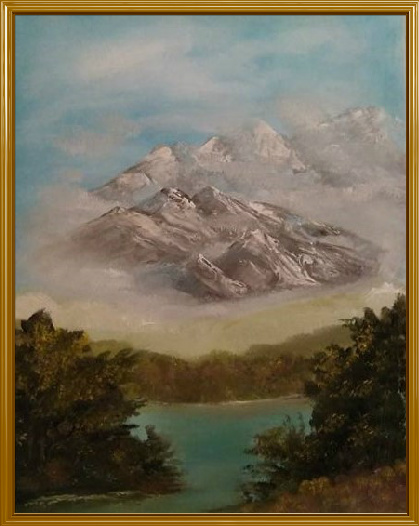
I’ve painted so many scenes like this. All good practice, of course, but just “basic landscape painting”. Call it Landscape Painting 101. Nothing really wrong with it, but nothing that really captures the heart, the mind, the imagination. Unless you’re my husband.
Years ago, when I was taking part in different art shows, I noticed that there were rarely any landscape paintings entered. I became curious and did a bit of research about the history of landscape painting as a genre. Why Landscapes? Why Not?
For a time I began to feel that being a landscape artist made me a “lesser” artist, and in some respects there’s a bit of truth to this. When we’re drawing or painting a still life, a human face or figure, even an urban scene, slight missteps become quickly noticeable. Not so much with landscapes. If I paint a mountain that’s slightly taller than my reference, is anyone going to notice? Is anyone really going to care? If a make a tree a bit thicker than it really is, or if I don’t capture the exact curve of a bend in the river, is it really going to “ruin” the scene? No, not at all. Whereas a mistake in a portrait would stand out in a bad way, little mistakes in landscape art simply go unnoticed, or at times, even become a point of interest!
Yet landscapes can truly be masterpieces. Landscapes can take our breath away. Landscapes can truly make us gasp at their beauty. I love looking at the incredible works of Asher Durand and other artists from the Hudson River school. I see works of tonalist artists and feel my emotions pouring out all over the place. I love landscape art — the beauty of the earth, the grandeur of nature, the majestic views that show the glorious wonders of this world in which we live.
At the same time, I love “little landscapes” too. Simple scenes of simple places. A few trees. An old log that’s fallen in the forest. A winding road through the fields. A peaceful lake. Simple things, but things that — for some reason — have meaning. Simple things, but things that bring memories, things that touch me emotionally, things that move me in some way.
Consider this simple landscape. Not a work of art, but I like it. I like the gray skies, the way the light falls over the landscape, the shadows on the tree. There’s nothing remarkable about this scene, but despite its imperfections, it makes me feel something for some reason.

So, what is this SOMETHING that makes one landscape painting stand out while another — perhaps even one more skillfully executed — just seems tiresome and jaded?
Several years ago I spent quite a bit of time studying landscape art, trying to discover this SOMETHING — and then, to learn how to create it in my own works. To some degree, I think I succeeded, having won awards for many of my oil landscapes. Many times judges commented on the “emotional aspect” of a painting, or specifically on “a sense of authenticity” they felt in my art.
That’s the first key, I think. As a landscape artist, I need to paint things that evoke feelings for me, scenes that bring back memories of childhood, images that create strong emotions within me. Successful landscape painting — meaningful landscape painting — is all about creating mood and atmosphere. It involves some technical skill and a bit of know-how, of course, but even more, good landscape art requires meaningful emotion. A good landscape painting makes us feel something.
This is what I’m going for in my landscape art, and to make a viewer feel something from my paintings, I have to feel it first.
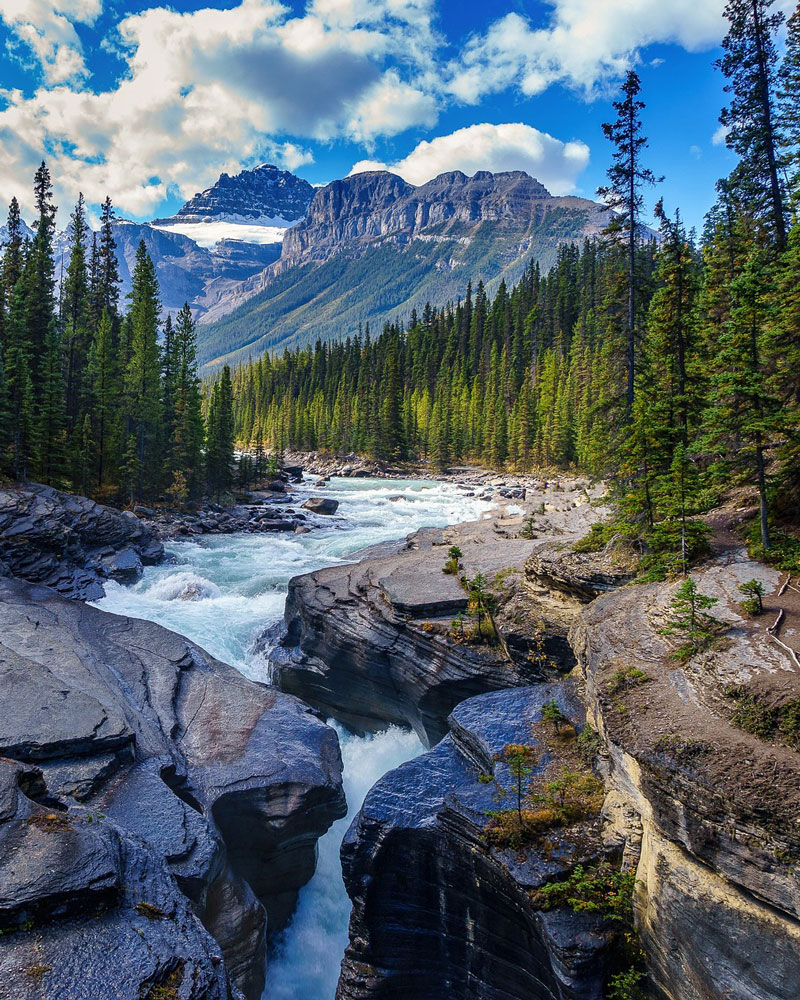
I’ve now started working on an “assigned” landscape project — part of an online class I’m taking. It’s a nice landscape scene. You saw my first tentative brushstrokes recently. Here is the reference photo we’re working from:

It’s a nice scene, and I’m sure one reason the instructor chose it for this class is because it offers us opportunities to develop skills in many areas: fluffy clouds, blue skies, mountains and snow, atmospheric perspective, evergreens, rushing water, rocks, lights, shadows. Yes, from an instructor’s viewpoint, this scene has everything we could ask for.
Yet in my eyes, this is “just another landscape”. It’s lovely to look at, but it doesn’t make me feel anything. So, I will paint along with the class. I will do my best — this will be my first oil painting since returning to the studio — and it will be good to practice painting all these different landscape elements. But still, my heart just won’t be in it, and that’s what matters most about landscape art.
It’s got to have heart.
 Artistcoveries
I like the landscapes you do that share the resonance you feel with specific places.
LikeLiked by 1 person
Thanks. Yes, we really do have to feel a connection to make our art meaningful. The piece I’m working on now just doesn’t “move” me, so it’s little wonder I haven’t gotten too far with the project.
LikeLiked by 1 person