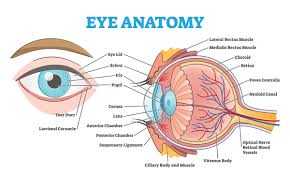
My husband and I both have vision problems, so we’re now both seeing the same retinologist. Between the two of us, we’ve learned a lot about eye anatomy and have seen the “insides” of our eyes through incredible medical photography — no idea what the technical term is for the machines that make these images or for the images themselves.
For what it’s worth, my husband will still require two more surgical procedures, and at this point I’m not yet sure what treatments will be needed for my retinal vein occlusion, but we’re getting along the best we can. Limited vision does make drawing a bit of a challenge, though.
Now, I’m going to make a few wild guesses here about drawing. I’m guessing that for most artists, accurately drawng human faces is probably one of the most difficult challenges. I’m guessing, too, that when it comes to drawing faces and facial features, eyes are probably the most difficult. I could be wrong, of course, and I’m sure there are many talented “portraiture artists” who find faces, in general, and eyes, in particular, among the easiest drawing subjects.
Once in a while — it doesn’t happen too often, but once in a while — I draw an eye that looks good. I won’t go so far as to say “realistic” — that’s far beyond my skill level — but one that moves beyond the clownish, childish-looking, cartoon-like eyes I so often draw.
If you do a Google search for “How to draw eyes”, you’ll come up with 10 pages of responses: text tutorials, video demonstrations, and helpful images for references. I’m sure watching and following along with any of the videos could be helpful, but — making another wild guess here — I think the real secret to drawing eyes is to learn the basic techniques and then practice them again and again.
This morning’s “drawing lesson review” was on the topic of drawing eyes, and considering that this was my first attempt in probably a couple years, I was pleased with the result. It looks like an eye!
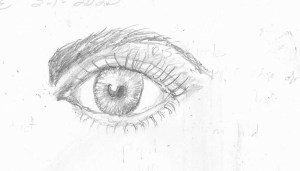
Now, if you look very, very closely, you’ll see “Iris” written there. I was drawing in my sketchbook and making notes about the process.
- Draw the shape of the upper lid
- Draw the bottom lid
- Be sure the tear duct is visible
- Draw the iris — the large circular shape — assuring that it touches upper and lower edges
- Draw the pupil, allowing an area for highlight
- Darken the pupil area, leaving the highlight
- Shade the tear duct area
- Shade the iris using tiny strokes outward from the pupil
- Continue shading the iris with strokes from the outisde toward the center
- Remembering the the eyeball is a sphere, add light shading at both edges
- Draw the upper lid
- Draw a lower lid area below the bottom edge
- Add light shading above the lid
- Add eyelashes
- Add brow
Wow! There are a lot of steps involved in drawing an eye, and I don’t claim that you should draw every eye using these exact steps in this exact order. Consider these more as “things to remember” about drawing these “windows to the soul”.
I’m read that many artists choose to have their subjects looking slightly toward the side when they draw portraits because having a drawing where a pair of eyes are staring directly at you can be a bit unnerving. I’ll attest to this. Even with my “not-the-most-realistic” eyes, I’ve sometimes felt that strange sense of unease when drawing eyes. Drawings don’t really have a soul, do they? Sometimes it seems they do!
While today’s “eyeball” isn’t a masterful work, it’s definitely better than some of the eyes I’ve drawn in the past. Here’s a quick look back from “Sketchbook #2” — covering the last half of 2015, the year I first began learning to draw.
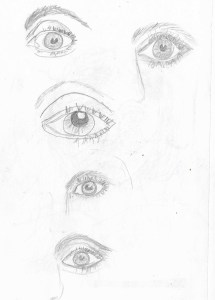
Another thing to keep in mind — it’s easier to draw a single eye than it is to create a “matched set” in an actual face! I think that’s probably my greatest problem. I may be able to draw one eye, but I can never get a second eye to match. Either it’s too large, too small, too wide, too narrow, or just too crooked… or as often as not my pair of eyes are too wide set, are too close set.
And I hate drawing eyelashes. I even wrote a post on this topic back in September 2019: Why Are Eyelashes So Hard to Draw? That post includes what is probably the best eye I’ve ever drawn with graphite.
One thing I am really starting to see is the importance of shading when drawing eyes. While I don’t intend to spend a lot of time drawing eyes — or faces, in general — as I’m reviewing these lessons on portrait-drawing, I’ll pay more and more attention to “getting a full range of values” there, even in an eye. And, for what it’s worth, I do think my practice with drawing spheres helps me see the eyeball in three-dimensional terms, thereby making it easier to understand where and how to shade.
If you’d like to practice drawing eyes, here are a few of the video tutorials available. Please note that I haven’t checked these out, so I can’t say how helpful they might be.
How to Draw a Realistic Eye Fast
How to Draw Hyper-Realistic Eyes Step by Step
How to Draw a Realistic Eye Narrated for Beginners
How to Draw a Realistic Eye Narrated Step by Step
I hope you find these links helpful — and I hope your eyes are better than mine!
 Artistcoveries
I agree! Eyes are hard. I also find hands difficult
LikeLiked by 1 person
Yes, facial features are extremely difficult because we’re so familiar with them. The slightest bit “off” — and the error looks glaring. Hands are also challenging.
LikeLiked by 1 person
That is a great explanation!
LikeLiked by 1 person
I think this is why I enjoy doing landscapes. If something in nature is a bit off, it’s not quite so noticeable!
LikeLiked by 1 person
That is truth.
LikeLiked by 1 person
That is a really good eye!
LikeLiked by 1 person
Thanks. It was better than I’d expected LOL. Overall, doing a few “facial features” was enough to remind me that I really just want to focus on landscapes! And maybe some still life… but definitely not portraits!
LikeLiked by 1 person
Well done! I appreciate all the steps you listed, too.
LikeLiked by 1 person
Having a list helped me. I have a habit of just rushing through things. When I have a step-by-step list, I can slow myself down a little.
LikeLike
I totally agree—eyes are really tricky to draw. They hold so much emotion and small details. It’s amazing that you’re still making art even with vision challenges. Wishing you relief from treatment and hope you keep creating in whatever way works best for you. 😊
LikeLiked by 1 person
Thanks for all the good wishes. I go back to the retinologist on Monday, so I’m hoping we’ll have a treatment plan determined.
LikeLiked by 1 person
Great tips for drawing eyes! I have a sketchbook from high school that’s all eyes, hundreds of them, I was getting pretty good at them, but now, just abstract! 😉
LikeLiked by 1 person
It takes a lot of patience to draw good eyes. A whole sketchbook! Wow.
LikeLiked by 1 person
Wonderful eyes, fascinating post! 👏👏👏 Yes, getting them to “match” is tricky. Someone once told me to make each stroke twice, once for each eye, instead of doing one eye completely & then trying to match it. Of course, the mirror-image placement (left eye vs right eye) can be tough no matter what. But I think that the gradual buildup of 2 at the same time can be helpful.
LikeLiked by 2 people
Interesting approach! If I ever do any portrait drawing exercises again, I’ll give that a try!
LikeLiked by 1 person