There is something to be said, I think, for “improvisational art” when we’re learning to draw and paint. To me, that term means “doing my own thing” and somewhat “trusting my instincts” rather than following along step-by-step with an art instructor.
This is the approach I took today as I reviewed a lesson on ink drawing. The subject was a country scene — you’ve seen such scenes many times, I know. A rustic barn, a fence, trees in the background and bits of grass in the foreground. I vaguely remember trying to draw the scene years ago when I first took this particular online art course. It probably didn’t turn out very well which is probably why I can’t find any such ink drawing anywhere around.
Now, there was a time, early in my art studies, when the very thought of drawing with ink terrified me! In fact, when I once did get brave enough to check out an ink-drawing class, I quickly changed my mind and quit. I felt bad about that at first, but then I realized that this is my art journey, no one else’s, and if ink drawing wasn’t “my thing”, so be it.
The funny thing, though, is that in time I did give ink drawing a try, and surprisingly I fell in love with it. Not that I’m good at it. No, not at all. But drawing with ink creates an interesting paradox for me. With graphite — where I should be loose with my pencil strokes — I tighten up. With ink, however — where precision and control should be key — I loosen up, let go, and have fun.
For me, ink drawing isn’t about meticulous detail. Absolutely no way. Ink drawing, for me, is just about relaxing and enjoying the process. I especially love “line and wash” drawings, combining both watercolor or gansai with ink.
And that’s essentially what I did for today’s lesson. Instead of fretting about drawing a barn — I’m not good at buildings, you know — I went right back to my current favorite subject. Pears. Yes, pears.
The project was to use ink to create a wash, do a little shading with the wash, and then to finish the piece off with a fine-line pen.
I used an acrylic ink with lots of water to make a very, very diluted wash. I quickly drew the basic contours with my HB pencil, then loosely “washed in” the ink. Yes, it spilled over the lines. Fine! Yes, it’s splotchy! Who cares? I absolutely loved doing this little “improvisational” ink wash and line drawing. I chose my own subject, chose my own materials, and I made up my own rules — which were essentially these:
Rule #1 – I’m in charge here.
Rule #2 – It doesn’t matter what this looks like as long as I’m having fun.
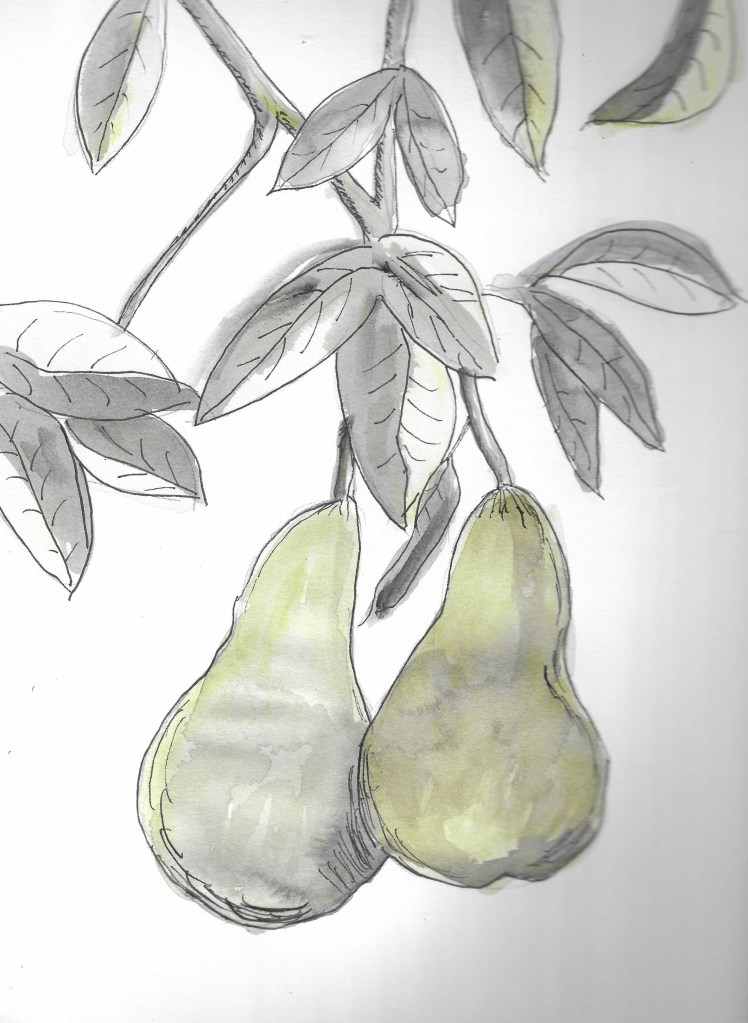
In this scan, some of the ink wash has faded from view. Oh, well. I still like it, not for its artistic value, but for the “artistic freedom” it represents. And oddly enough, as I look around the studio I find that many of my favorite works were done in a similar “improvisational” style. In other words, they were just fun little things I did on my own, practice pieces where I made my own choices about materials, colors, or techniques.
At it’s heart, this is really what art should be about, but, of course, for a student who’s just beginning to study or for someone like me who is re-learning a lot of basics after a bit of time away, art too often gets pigeon-holed into assignments, lessons, and tutorials where the true sense of art is set aside as we try following instructions.
I guess in a way, the whole concept of “art instruction” is a bit of an oxymoron. Of course we need teachers to show us the way, but as often as possible, we need to make our own way. Copying works of art has long been touted as great practice, and definitely we learn from watching demonstrations and tutorials. Instruction is good, but improvisation is better, as often as not. Once we learn the basics, it’s time to stop following others and create a path all our own.
 Artistcoveries
You are really on to something there. Lovely drawing!
LikeLiked by 1 person
Thanks. It was a fun drawing. Sometimes we need to make our own rules and just do whatever feels good LOL
LikeLike
This is lovely! This shows your style that I was gushing about in a previous reply. Really love this.
LikeLiked by 1 person
🙂 Thanks. It was fun to do this.
LikeLiked by 1 person