
I was a cheerleader in high school, and “2, 4, 6, 8, who do we appreciate” was one of the cheers we did at each game. I found myself repeating that little cheer this morning in my art studio, not as a cheerleader — although maybe I need one — but just as part of yet another pencil shading exercise.
Having identified “shading” as one of my weakest areas in graphite drawing, I’ve been pushing myself a bit, you see. I spent several hours yesterday watching video tutorials, browsing drawing books, and playing in my sketchbook, trying to get a better understanding of how to shade.
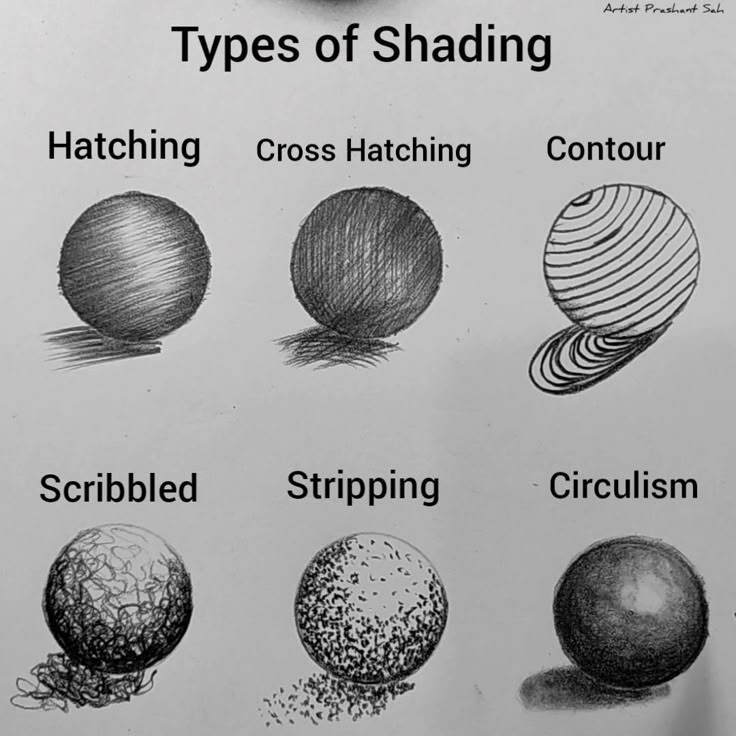
For what it’s worth, I know the techniques. There’s hatching, cross-hatching, circulism, scribbling, scumbling, contour shading…and on and on, with different instructors perhaps giving different names to the same techniques.
One of the more interesting videos I found is from Prashant Sah, who shows a few of the most popular shading methods — and demonstrates how to create them. In the video, do note that “stripping” should be “stippling”, and it is a helpful technique.
Here is an image from the tutorial:
As I read, watched, and practiced, I gradually came to an interesting realization. I do know all of these techniques. I can execute these techniques — at least when it comes to doing simple practice exercises — and I understand all the concepts involved in graphite shading, things like knowing the different grades of pencils, understanding different pencil grips, knowing how to vary the pressure, and even having a fairly good knowledge of light and shadow. Yet none of that has helped me learn to shade properly. Why not?
Aha! I had a flash of insight as I pondered this question. Perhaps shading isn’t really the problem. Where I really fall down is with blending. I’ve done some “shading exercises” in the past where blending was not used. An example is in the post “Five Tone Shading” where different values are applied but not smoothed or blended. I was pleased with the results from that exercise.
Most graphite drawings, however, require not only creating values but also blending them for smooth gradations and transitions. This is a more accurate representation of how light and shadow behave.
My main problem, I quickly realized, was a sense of “messiness” I have whenever I try to shade and blend. When I look at my drawings, it’s this “messiness” that I see first, and so I’m now working on being a neater artist. I’m not sure I can do it, though.
I have learned to start my drawings with a very hard pencil — a 4H seems to work well for me. But then I find myself in a bit of quandary. Over and over we’re told to be sure we have a full range of values in our graphite drawings, and this requires using softer pencils and darker marks, and once I get into the “B” grade pencils, my marks become not merely dark, but messy. Very messy.
Then, as I attempt to blend my shading… well, the mess just gets worse and worse. I end up with graphite everywhere. Dark areas get smudged beyond the contour lines; lighter areas become too dark. I find myself — as in yesterday’s pear drawing — erasing, re-shading, erasing again, and all the while making bigger and bigger messes!
So, this morning for my art practice, I went searching for instructions not on shading, but on blending. I found a tutorial to follow, and I have learned a few things from it, but I still ended up with yet another messy drawing.
The exercise involves using 4 pencils — a 2B, a 4B, a 6B, and an 8B — so I grabbed my drawing kit and started cheering myself on. “2, 4, 6, 8…!” The exercise — like so many other shading/blending exercises — involves drawing a sphere, which is simply a circle that’s shaded to appear three-dimensional. Remember those elements of art that include shape and form? This is the basis of all realistic drawing. Lines create shapes, and we then use shading to turn those simple shapes into forms.
Without further ado, here is the drawing I completed. My husband just strolled by, saw the drawing, and commented “It looks round”, so I guess I accomplished the essential purpose. But, again, to me, it just looks messy.
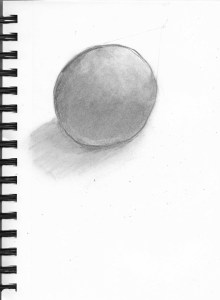
Let me point out here that the instructions were to first draw a circle — which I did in 4H — and then trace over the circle with the 8B pencil so that we could clearly see our shape. My original circle was slightly larger and a bit better, but I’m not good at “re-tracing” lines I’ve drawn, so when I went over the original lines…oops, well, I missed and ended up with a smaller, lopsided circle. I then took an eraser and did my best to erase the original line.
This exercise is all about layering and blending, first with a 2B pencil to lay down a smooth tone that transitions from light at the top (where the light source is) to the darker edges away from the light. Originally I also drew in a small arrow to represent my light source and added diagonal lines to indicate where the shading would begin. I can’t say that it helped much!
Layer by layer, the process evolved. Shade, then blend. Shade, then blend. First with a 2B pencil, then with a darker 4B, and next with a 6B, and finally with 8B, putting down two layers with each pencil and gently blending between each. Then to finish it off, the lighter areas can be lightened a bit with an eraser.
Oh, dear, there I was again, shading, blending, erasing… and doing my best, yet still feeling that my work was too heavy-handed, much too messy.
Of course, much of the messiness might be avoided if I were a bit more careful, a bit more patient. Art definitely requires patience, which has never been one of my virtues. I tend to rush, to take short-cuts, to ignore good advice simply because it’s inconvenient.
What do I mean? Well, let’s consider a few simple facts:
- Graphite does move about. This is why we’re able to blend it and create smooth transitions, but this is also why it can easily end up where it doesn’t belong.
- To avoid smudging graphite, we can use a sheet of paper over already completed parts of a drawing as we work on other areas.
- Blending stumps and tortillons are great, but they need to be cleaned, otherwise it’s easy to add graphite to areas as we blend. A good way to avoid this — for me — is to blend with a tissue instead. I can always find a clean spot to use!
- Like stumps, erasers can become dirty with graphite and can lead to messy smears. Erasers can also deposit little “crumbs” (for lack of a better word) that will really ruin a graphite drawing if they’re not carefully brushed away.
With today’s exercise, I did try using a sheet of paper to avoid smudging as I worked, and I did avoid any dirty blending stumps. I’m still not satisfied with my results, though.
So, please, help me out here! How can I create a full range of values — darker darks and lighter lights — without making a mess with my blending? I suppose the answer is to keep practicing, to slow down, to build up values layer by layer. At least I think I’ve identified the real problem so I can work more on blending techniques rather than watching more videos about shading techniques.
In the title of this post, as I recited that old high school cheer, I posed a question: Who do we appreciate? Taking that at a personal level, I appreciate all the artists and art teachers who have taken time to share their talents through books, videos, and online courses. And I appreciate YOU. Thank you for reading this blog. I’m grateful for all the support you’ve offered through these long years of learning how to become an artist and for all the helpful suggestions you’ve given me. As “Artistcoveries” nears its ninth anniversary, I’ll say I’ve certainly come a long way, and I couldn’t have done it without YOU! Thank you.
 Artistcoveries
do you have a fairly new gum eraser, the kind that’s like putty and can be reshaped? I don’t like pencil lines to show in watercolor, so before painting I would roll the gum eraser lightly over the sketch. Clean but not invisible. Of course, it will get dirty fast over soft graphite. But it recovers with reshaping. And I think your sphere looks very good.
LikeLiked by 1 person
Yes, I just got a new kneaded eraser. One of the cats “borrowed” the one I had. Hopie thinks it’s a great toy!
LikeLike
I like it a lot! It doesn’t look messy to me. I always enjoy a bit of graphite on the paper, for texture, anyway.
LikeLiked by 1 person
Thanks. I’m trying my best to be a little neater, but it’s not easy LOL.
LikeLiked by 1 person