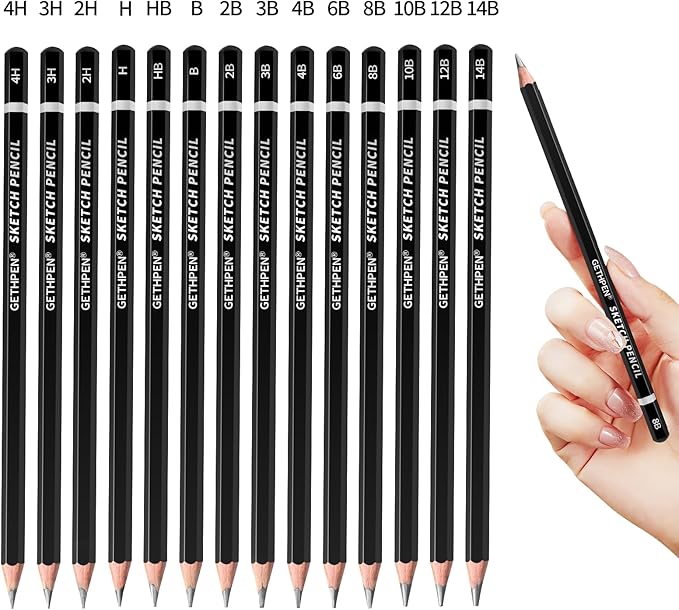
The drawing lesson I reviewed this morning focused on graphite. I’m guessing that just about everyone who wants to draw — or learn how — starts with a simple graphite pencil. That’s certainly where my art lessons began. At the time — June 2015 — I had a little knowledge about art pencils, but I also had a lot to learn.
Now, of course, in reviewing an introduction to graphite, there really wasn’t anything new for me to take away from the lesson. I’ve worked with graphite — in various forms — enough over the years to develop a basic knowledge of its properties and uses.
For those who may be new to art and graphite drawing in particular, here are the basic facts you’ll need to know:
- Graphite art pencils are available in a wide range of hardness. These go from very, very soft to extremely hard, with each different pencil producing a different mark.
- Softer graphite produces darker marks; harder pencils create lighter marks.
- Even with a single pencil, however, we can make both lighter and darker marks depending upon the amount of pressure we apply.
The lesson also mentions various types of graphite drawing materials available. In addition to the familiar pencils we all use, and the more refined “artist drawing pencils” in different hardnesses, graphite can also be purchased in powdered form, in thick square “sticks”, as woodless pencils, and in a water-soluble form. If you enjoy graphite drawing, you’ll definitely want to try out these different forms.
The lesson goes on to discuss blending tools.
- First, never blend graphite with your fingers. Your skin has oils which will make a mess of graphite. (You will find, however, many videos and instructors who don’t follow this rule.)
- Second, tortillons and blending stumps are available — and inexpensive — so buy them and use them. Or, you can grab a tissue for quick blending.
- Third, you can make your own blending stumps with paper.
So, now you know all about graphite, but most likely you knew all of these things before. As I reviewed the lesson, I nodded, yes, yes, I’m familiar with different grades of pencils, and yes, I know all of this information. You might think now that I really learned nothing from reviewing this introduction to graphite drawing.
Actually, however, I learned a lot, not from the information presented, but from doing a little graphite drawing. In the course video, Matt Fussell, the Virtual Instructor, draws a pear. Pears, much like apples, are fairly easy to draw, right? Basic shape. A bit of shading. Voila, it’s a pear!
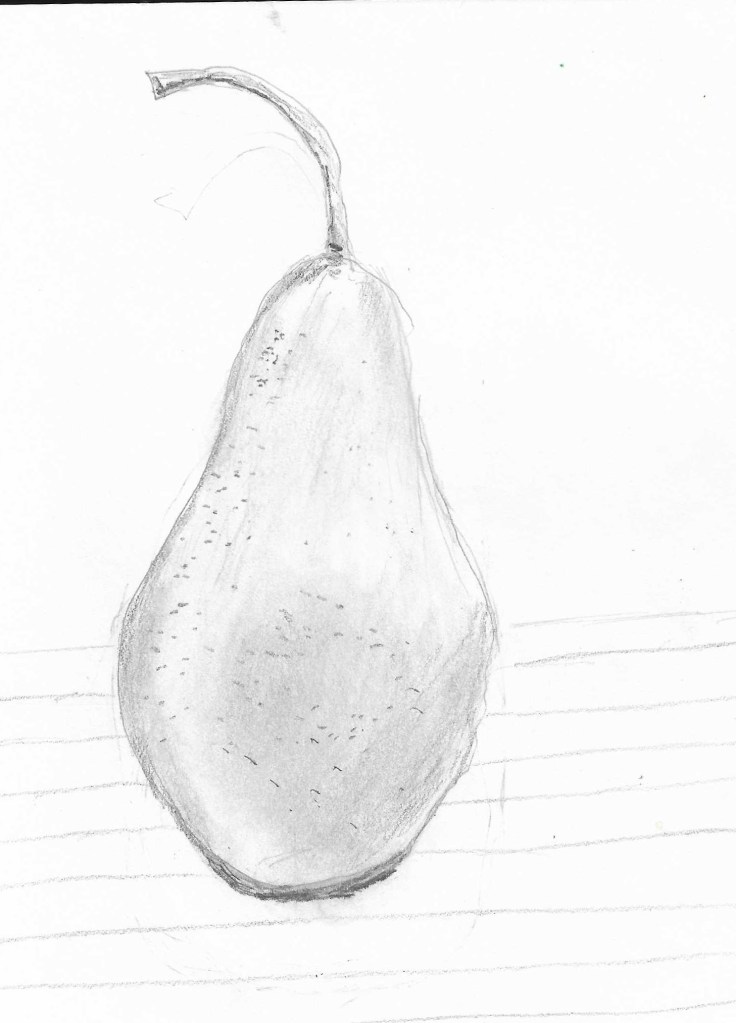
Now, I make no claim that my pear — shown above — is a great pear. I do attest, however, that it IS recognizable as a pear. And I do think I made a good representation from my reference photo.
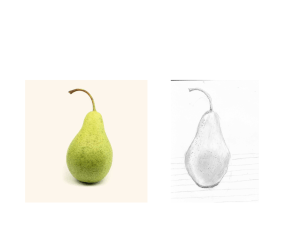
OK, so maybe my pear is a little skinnier, and OK, so the shading isn’t perfect. Still, it’s a pear, and it’s at least a reasonable facsimile of the pear shown in the reference photo. For me, this pear represents a job well done, a successful little art project, and most of all, a definite learning experience.
This is the point of the post. While I didn’t learn anything new from the information in the video, I learned a lot about art, and a lot about myself as an artist.
As I’ve mentioned before, at the end of each lesson video at the Virtual Instructor, he asks: What did we learn today?
Oh, so much!
- I have always been “heavy-handed” in drawing. Part of it comes from being clumsy and akward, and holding my pencil with a sort of “death grip”. I’ve learned now to always start my drawings with a very hard pencil — such as a 4H. This allows me to make a lot of lines, to be a little more free in my initial sketching. Mistakes can be easily erased. Basically, I did the entire pear drawing as a “rough sketch” with my 4H pencil before switching to a softer lead.
- Shading has always been a weak area for me, so I know I can improve my drawings by working more on shading techniques. Focusing on this particular aspect of the drawing process will definitely be helpful. I know, too, not to expect perfection, especially now as I’m just getting back to a regular art practice.
- My original contour of the pear was a bit wonky. It was taller and thinner, and while it still looked like a pear, it wasn’t really a good representation of the reference photo. In the past, I probably would have shrugged it off, said “Oh, well, I tried” and just continued with my wonky-looking pear. Not this time. Since my marks were lighter and easier to erase, I took a little time, studied the reference photo more closely, and made a few corrections. I still didn’t get the shape “perfect” — but that’s all right. It’s close, and for me, the willingness to stop what I was doing and start over was a significant step.
- One of the most important things I learned today was that I really do enjoy graphite drawing. When I set out in June 2015 to “learn to draw”, that’s really as far as my thinking went. To me, being an artist simply meant having the ability to pick up a pencil and draw something recognizable. I never thought of art styles, different media, various techniques, color theory, or any of the other aspects of art. I just wanted to develop the ability to draw. And as I learned, I discovered that drawing with graphite brings me an immense feeling of satisfaction. It’s partly a sense of accomplishment, but yet it’s more. It’s not just getting a good result, but it’s the fact that I enjoy the process. There is something very soothing about sitting quietly with a pencil and a sketchbook and making lines on the page. There’s a quiet sound if you listen closely. There’s gentle movement. There’s a certain focused awareness — much like meditation — that is very pleasurable. Yes, I do enjoy graphite drawing. Even if I’m not great at it, I enjoy the process.
If this were all I learned from today’s art lesson, I’d call it quite successful. There was, however, one thing more I learned, one thing that is perhaps the most valuable lesson.
I had fun drawing this pear, and I thought about how many times in the past I’ve drawn or painted pears. Then I began browsing through the blog, going all the way back to March 2016, the month when Artistcoveries first began. A post there — What Shall I Draw Today? — featured one of my first, rather sad, attempts at watercolor. I won’t show it again here, but it was good to look back and see for myself that my art skills did, indeed, improve in time.
What really caught my attention, though, was what I wrote:
It’s said that the best way to get to Carnegie Hall is practice, practice, practice. It’s also said that “practice makes perfect”. Whoever said that wasn’t speaking of me and art. I’ll never achieve perfection, will never master any medium, and will never win any awards for my work. But practice does make me better.
I did a double-take when I read that. I did, you see, go on to win awards for my art. It began with a single “Judge Merit” award, a little moment of triumph that made me realize that I did have some artistic ability. As I displayed work in more and more shows, I brought home more and more ribbons — including a first place award that included a nice monetary prize. So, the point here is this: Don’t ever tell yourself that you can’t learn to draw. Don’t ever discount your ability. Just keep going, keep learning, keep trying. You’ll be surprised at what you really can do.


My favorite blending tools are Q-Tips. Have been almost all my life. And when their cotton tips get “dirty,” they make interesting tools to draw with.
LikeLiked by 1 person
I’ve used Q-Tips before. I’d forgotten about them, so thank for the reminder. I have some in the medicine cabinet. I’ll bring a few down to the studio.
LikeLiked by 1 person