
I’ve mentioned several times that even while I’ve been away from “art” for quite some time, I have recently done a lot of brush lettering. Well, brush lettering practice, that is. I don’t really think of lettering as an art form, although it probably is.
In a previous post — from December 2020 — I shared my personal story of handwriting, so I won’t go into it here other than to briefly mention that copying letters over and over is something I’ve done many, many times.
Back in the 80’s I did learn a bit of calligraphy, but I was never very good at it. Then in 2020, I tried hand-lettering, or brush lettering as it’s usually known. It might be viewed as an easy alternative to traditional calligraphy, although at first I wasn’t finding it all that easy.
As they say, though, practice… well, it might not always be true that practice makes perfect, but practice most definitely will lead to progress, and I’m very happy to say that I’ve made great progress with my brush lettering techniques.
The basic idea behind brush lettering is to create a script that looks impressive, has some resemblance to calligraphy, but which requires simple tools and is easy to do. Here is an example — which I’ve shamelessly copied from Amy Latta’s excellent website.

To learn brush lettering, you really only need to remember two things:
- Thick on the downstroke
- Thin on the upstroke
Simple? Yes. Easy, yes, again, but only after a bit of practice, and only with the right pens. The ones I’m using are Tombow’s Fudenosuke Dual Brush Pens. Although I’ve experimented with a few other “brush pens”, these are the best, in my opinion. They’re also the pens recommended by Amy Latta, whose tutorials and practice sheets I’ve been using.
In the past, the biggest problem I had was connecting one letter to the next. Thanks to Amy’s tutorials, I’ve finally figured it out. Not that I’m an expert at it yet, but I’m getting better.
In the December 2020 post, I shared a link to a practice pad available from Amazon. Here it is again: Calligraphy Paper for Beginners. If you have any desire to learn brush lettering, do yourself a favor and get this practice pad.
Of course, just having pens and paper isn’t enough. You have to add one more thing: practice. And lately I found myself in a position where I had plenty of time for that. As many of you know, life has been challenging here lately, and I’ve found the quiet, repetitive process of practicing letters to be an excellent way to relax and de-stress, as well as a great way to pass the time while my husband has been undergoing various medical procedures. During a recent 3-hour wait in St. Luke’s surgical waiting room, I filled page after page after page with letters and then words. Here is one example page from that very long day.
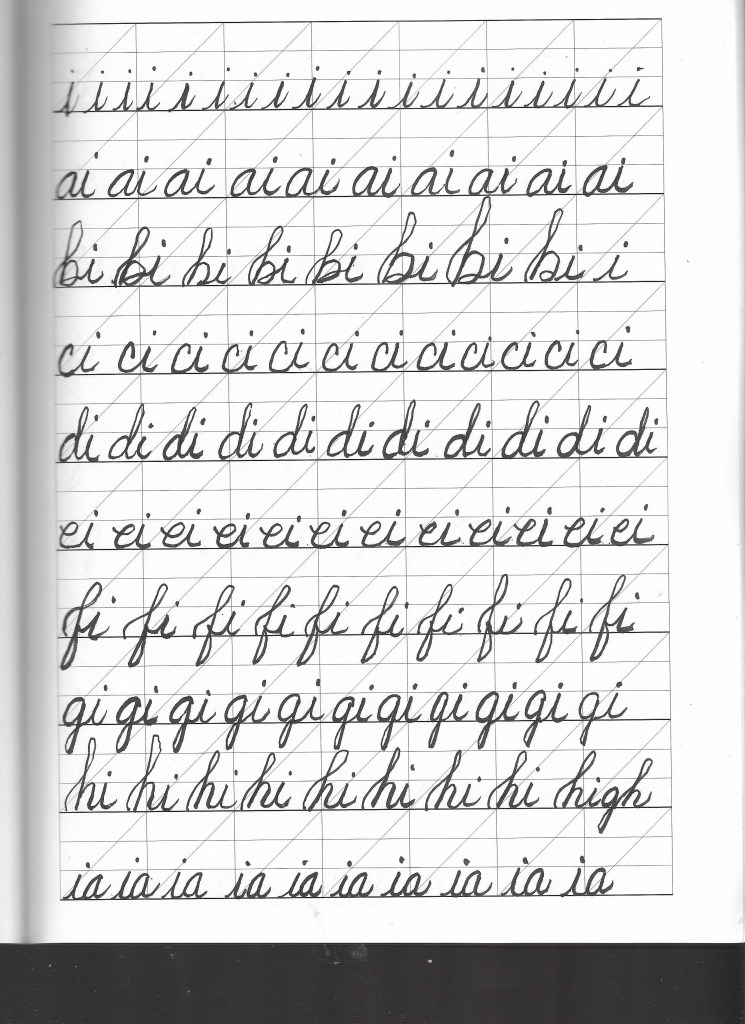
I’ve been all the way through the alphabet doing “practice pages” and I’ve filled more “practice pages” with random words. What I haven’t yet done is to actually put my newfound skill to any practical use! I’m still more comfortable practicing than trying to use brush lettering.
Throughout it all, I’ve learned not only the basic principles of “thick/down” and “thin/up” and the method by which letters are “connected” — they really aren’t, but they appear to be — and I’ve learned, too, that everyone develops their own style. While my letters are all close in appearance to those shown in Amy Latta’s practice pages, my slant is a bit more pronounced, and a few of my letters represent personal “preferences” — ways of forming letters that I’m comfortable with.
I think that’s perhaps the best lesson I’ve learned. In every form of art, we have to accept our unique style; we have to allow ourselves the right to express ourselves authentically. With drawing and painting, that’s been a difficult lesson for me to fully accept. With brush lettering, however, I’ve developed enough confidence and understanding of the process that it’s all right. I can give myself permission to develop my personal style and not feel that I’m doing something wrong if my results differ a bit from an instructor’s examples.
Now, what will I do with my brush lettering? I might find uses for it if and when I ever attempt art journaling again. One of the reasons I gave up art journaling was because I struggled so much with lettering! It will definitely be a useful skill when I create birthday cards or other holiday cards, so there’s that. Mostly though, what I’ll probably do is practice, practice, practice. It’s fun to sit quietly with my pens and focus my attention on lettering. I carry my practice book around with me now wherever I go, or if I’m just sitting down with my husband while he’s watching television. And as I fill page after page, it’s nice to see all those bold black marks in the book and feel that I’m actually doing something beautiful.
Is it art? Maybe. Maybe not. But it is beautiful, and I’m pleased that I’ve made the progress that I have.
 Artistcoveries
very inspiring! Purely by coincidence, I found 2 working brush pens in my art materials yesterday! Tried them and put them back. Now I’ll get them out! My husband had brain surgery twice, a year ago, and I hope yours recovers as well as he did. But waiting at the hospital was hard. Glad you used the time so well. You’re good to have back on the blog!
LikeLiked by 1 person
I hope all is well for your husband. Over the past year-and-a-half, I’ve spent far more time in hospitals and emergency rooms that I’ve ever wanted! Yes, doing the brush-lettering was an excellent way for me to pass the time while remaining relatively calm! That book of practice sheets stays in my “go bag” now along with a supply of pens. My husband will have 2 more eye surgeries coming up.
LikeLike
the two of you are in my thoughts. My own cataract surgery went well. I hadn’t realize that my world was getting yellowish until bright white returned!
LikeLiked by 1 person
I’m hoping it will make a significant difference for my husband. His diabetic retinopathy made the surgery such a challenge. It had to be performed by a special surgeon under anethesia at a hospital, and then there were problems afterward with the retina detaching, so he was whisked back in for a second surgery. All good thoughts and prayers are greatly appreciated! He has a follow-up tomorrow, so maybe we’ll learn more about the timing of the next two procedures.
LikeLike