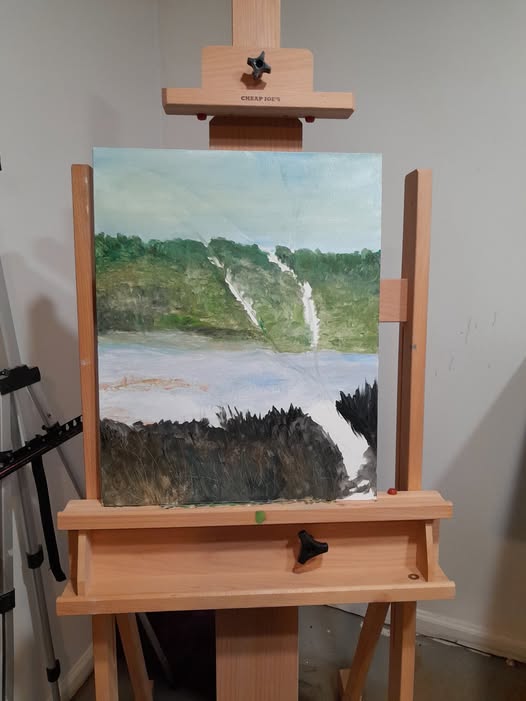
Now that I’ve actually gotten back to the studio and, more specifically, back to painting, I figured I might as well get started on another landscape. With one painting “under my belt”, I was able to approach this project with a little more enthusiasm. I won’t say I have any more confidence, but maybe at least I have a little more courage.
Over the years when I was actively painting landscapes, I did develop a bit of a process. It begins, usually, with a very rough sketch, most of which will be covered up, but which serves as a starting point to help me visualize the scene, get a better feeling for the proportions, and help me begin seeing the various “areas” involved. This last step is about value. The idea is to look at the rough outline and see where the lightest area will be, where the darkest areas will be, where areas of medium value will be. This is extremely helpful.
Once I have the rough sketch drawn onto the canvas, I move to the next stage of the process. This is a bit of a “color block” — although the colors aren’t exactly what they’ll be when the painting is finished. Again, it’s mostly a matter of values — making sure those various areas are clearly different values.
At this stage, a painting doesn’t look like much, but that’s all right. It’s not supposed to look like much right now.
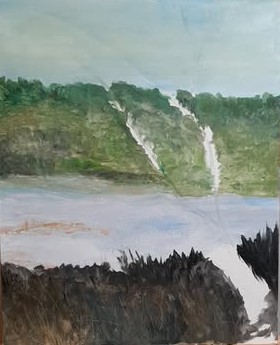
.
I’d venture to guess that you really can’t tell exactly what this is going to be. Oh, you can probably see the sky, most likely can guess that there’s a bit of water, grass in the foreground, and those are probably wooded hillsides in the background… maybe? But what are those blank splotches? And, yes, if you look closely you can see a few odd-looking lines in the sky.
Well, what you’re actually seeing is an unpainted tree with long limbs that stretch up and across the canvas. Most of that “background” will be covered with more tree branches and lots of leaves, A good part of the sky will be covered, too, so that only little bits of the light blue will be peeking through the foliage.
The riverbank will eventually be better defined, and there’s a little “brushy” area there at the moment. Right now it’s very vague and uncertain, but that will be one of the last details to be worked on.
I’m really looking forward to painting this tree, just because I’m eager to see how well I can do it. Can I get the right effect for the trunk’s texture? Can I get the lights and shadows “just right”? And can I put in not just the major limbs that take up so much of the scene, but also realistically create all the other branches dangling here, there, and everywhere? And what about the leaves? Can I do it? That remains to be seen.
This is a larger canvas than the one I just finished. This is 16 x 20. That gives me more canvas to cover, more opportunity to practice various brushstrokes, more practice in getting proportions correct. My plans will include making the water a bit lighter in value. As mentioned before, I will be re-defining the riverbank area and adding some details.
Can I do it? Well, yes, sure I can do it. But can I do it right? That’s the real question. Or will I end up with blobs of paint that bear no resemblance to leaves, and a weirdly misshapen tree that looks like something straight out of a kindergarten class? Will my water look like a real river? Will the marshy reeds I add look like they’re really part of the scene?
Who knows! But stay tuned. I probably won’t be working on this again until the weekend, but at least I’ve made a start, and while it doesn’t look like much right now, it actually does look about the way it’s supposed to look at this stage. Especially from a distance. As I sit here, I can glance over at the easel. It’s about 10-12 feet away. Yep, I can see different areas with different values. I do need the water a bit lighter, and that’s the point in doing this. This “rough block-in” of values helps me see what’s needed.
So, be watching. I’ll have more to share in a few days.
 Artistcoveries
What an interesting start! Thanks for sharing your process.
LikeLiked by 1 person