
Because I am doing little — if any — art work worthy of sharing, showing, and discussing, I recently asked for ideas and suggestions for blog posts. Fellow blogger and artist Matt Snyder commented that perhaps I could do something on “pop art”. I readily agreed because I quickly realized that “pop art” is a category I’ve rarely mentioned here at Artistcoveries.
Now, when you hear the words “pop art”, what “pops” into your mind? Probably Andy Warhol and his infamous soup cans. I don’t need to show you any of these works. You’ve seen them countless times since their creation in the early 1960’s.
You might think, too, of some of the really “far out” artists and their works, but let’s not spend too much time today talking about bananas taped to walls or other extreme examples. In fact, let’s just move on … but where?
I’ll be honest here. One of the reasons why I’ve never shared much on the topic of “pop art” is because it’s largely an unknown area for me. Beyond Warhol and a few of those artists whose work we’re not going to mention, I’d be hard-pressed to name any other “pop” artists. Maybe the best I could do would be to talk about a few of my artists in my Sims 4 game — yes, I love playing artists. I’ve had a few who specialized in the “pop art” category. Shown below are a few examples of paintings our “pixelated people” can paint.

.
The Sims franchise itself is a bit of a “pop culture” phenomenon, so maybe that’s why I so often have my artists in the game choose this category for their works. That’s “simulated life”, though. What about my “real life” experience with pop art?
Again, I have to admit near complete ignorance. So, off I went on a browsing expedition, visiting various sites, looking at modern “pop art” images, and getting acquainted with many well-known names. And before long, I felt like I was swimming in a vast sea of new knowledge. Or, actually, I began to feel more like I was drowning in all the pictures and ideas and influences and… whew! There’s a lot to discover with pop art. Where could I even begin?
What Is Pop Art?
I’m the sort of individual who needs structure and simplicity, so for me it’s always important to define concepts. I don’t want or need to know everything, but having a basic understanding is helpful.
“Pop art” is an art movement that emerged in the 1950s and 1960s in the United States and in Britain. It derives its name from various “pop culture” elements which artists incorporate into their works — elements such as advertising, consumerism, and everyday, ordinary objects, such as soup cans.
Another key aspect to pop art is its brightness and boldness. Pop culture artists have challenged our traditional thinking about art by using graphic imagery, a “comic-book” style, and images that reflect the ironies of life or which are satirical in nature.
For me, perhaps the greatest revelation in learning about pop art lies in finding the narratives these pieces present. They are not just simple drawings and paintings. They are stories within themselves, reflections upon our cultural norms, statements about who we are and what we value.
Yes, I’m Drowning — And So Is She!
As I was floundering about online visiting various websites and exploring collections of pop art, I came upon Roy Lichtenstein and this painting, one of his most famous works:

.
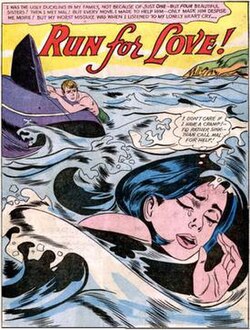
“The Drowning Girl” was painted in 1963 and is presently on display at the Museum of Modern Art in New York City. The inspiration behind this oil and polymer painting was a comic strip drawn by Tony Abruzzo which appeared in DC Comics the previous year.
.
There has been some interesting discussion about the similarities and differences between Abruzzo’s original comic and Lichtenstein’s creation of a very similar image. Abruzzo’s drawing was larger, showing the drowning girl’s boyfriend, Mal, clinging to a capsized boat in the background. Lichtenstein cropped the image to focus only on the drowning girl, changed the caption, and gave the boyfriend a different name. Is this enough to claim “Drowning Girl” as an original work of art? We must ask, too, why art lovers and critics place such value on Lichtenstein’s “painting”, yet relegate Abruzzo’s work to a lower echelon, as “only a comic book”. Lots to think about!
What Is the Narrative? OR Is There a Narrative Here?
I wrote earlier about narrative, about how pop art — and other forms of art, as well — reflect upon who we are. And it is here, with The Drowning Girl, that I, too, find myself fighting waves of turbulence, struggling to keep my head above water, and feeling as helpless as this “tragic woman” — a thematic element in much of Lichtenstein’s work.
What is he trying to tell us here? I’ve read that he was challenging the absurdities of gender stereotypes from the early 1960’s, yet in my eyes, he’s clearly reinforcing the belief that a woman must have a man in order to survive. Some critics agree; others skip over gender-related issues entirely and speak of Lichtenstein’s desire to “blur the lines” between “high” and “low” art.
The painting has been called a “masterpiece of melodrama” , and the Wikipedia page for this entry provides a bit more information about Lichtenstein’s methods of portraying women:
The subject of Drowning Girl is an example of Lichtenstein’s post-1963 comics-based women who “look hard, crisp, brittle, and uniformly modish in appearance, as if they all came out of the same pot of makeup.” In the early 1960s, Lichtenstein produced several “fantasy drama” paintings of women in love affairs with domineering men causing women to be miserable, such as Drowning Girl, Hopeless and In the Car. These works served as prelude to 1964 paintings of innocent “girls next door” in a variety of tenuous emotional states. “In Hopeless and Drowning Girl, for example, the heroines appear as victims of unhappy love affairs, with one displaying helplessness … and the other defiance (she would rather drown than ask for her lover’s help).” Drowning Girl, the aforementioned works and Oh, Jeff…I Love You, Too…But… are among those tragedies that make the author a popular draw at museums.
I’m not too proud to ask for help! I’ll admit I’m sinking here, totally flailing about, unable to really understand the message and meaning behind “The Drowning Girl”. Or, is there anything to be found? I’m sure fans of Lichtenstein will be quick to step up with lengthy, detailed explanations of every aspect of this — and other — paintings. For myself, I’m not so sure.
Maybe the message is simple and doesn’t need to be taken apart and put back together in a dozen different ways. Maybe all Lichtenstein is telling us is that we consume a lot of “meaningless garbage”, that we’ve become a society that consumes more comic books than literature, that we’re content with seeing stereotypical characters following predictable scripts, that we can no longer distinguish between fine art and cheaply-printed “mass market” offerings.
But, what do I know? Nothing. Absolutely nothing. So, Brad — or whoever may be reading this — I will ask for help. What do you see in The Drowning Girl? What does it mean to you?
Let’s talk!
 Artistcoveries
First off thanks for the shout out, 2nd…i happen to love Lichtenstein, good choice.
LikeLiked by 1 person
Great! I’m still trying to figure out what he’s trying to say with “The Drowning Girl”, so any comments you’d like to make will be appreciated!
LikeLiked by 1 person
Statement ? I think it’s all about capturing the technique of the dot process printing of old comics panels. I personally don’t think all art is meant to make a statement.
LikeLike
Yes, I read about the “dot process” — and you could be right. It’s too easy to “over-think” a work of art — visual, literary, musical — especially when there are so many “critics” who want to tell us what everything means.
LikeLike