
I remember doing a “white on white” drawing challenge back in September 2021. This was the result:

The challenge, obviously, was to use graphite to draw two white eggs on a white cloth. It was interesting, and in looking at it now — from a distance of several years — I think I did a fairly good job. The eggs are white; the cloth is white. I more or less accomplished what I set out to do.
Lately, as part of my “100 Days of Shapes and Forms”, I’ve been incorporating eggs into my drawing practices. These are white, wooden eggs that I got out as Easter approached. Why not add them to my exercises?
I not only added the eggs, I purchased a lovely new “egg-shape template” to help me achieve the proper shape and size for my drawings. Previously I had a ellipsis template, but the ovals weren’t as large as my wooden eggs, and I am going for more accuracy here.
So, I’m all set. Should be simple enough, right?
Yes. No. While I can use my new template to successfully get an egg shape on the page, I can’t make it appear to be a “white egg” — and here’s the reason why. These eggs are NOT white, at least not when it comes to depicting them in graphite.
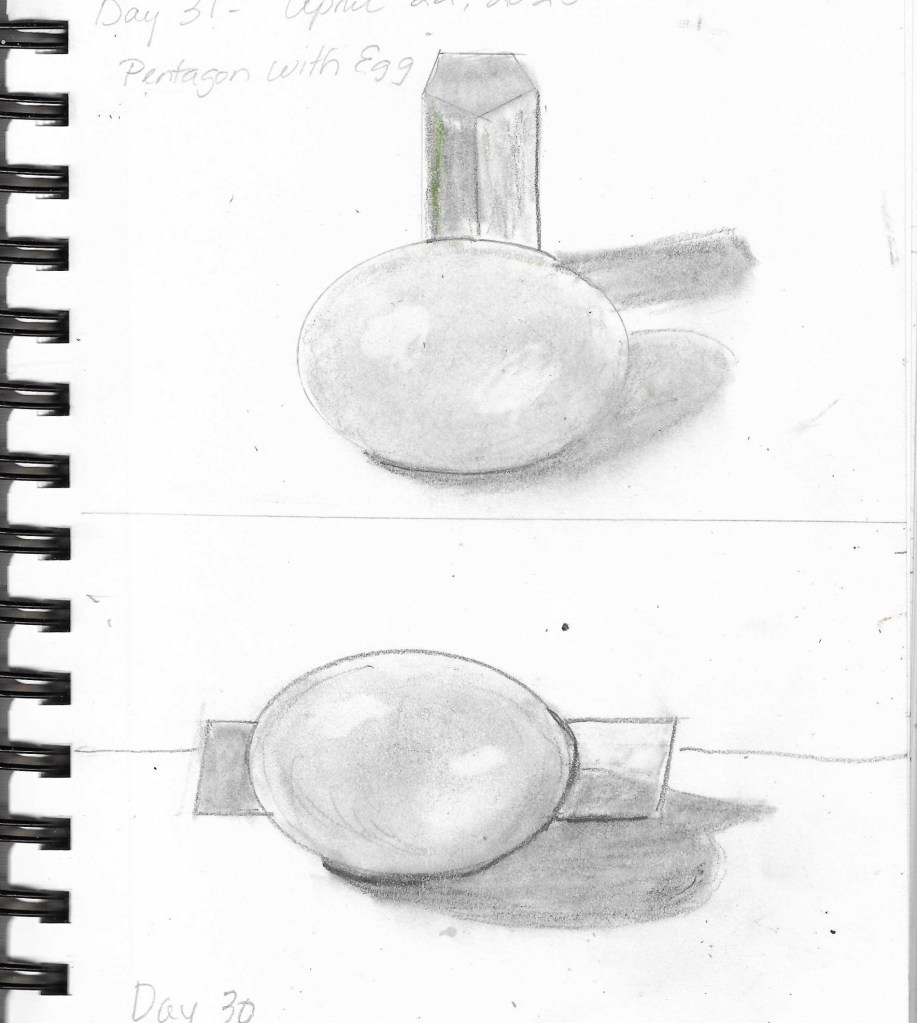
Here is a page from my sketchbook showing two separate “Shapes and Forms” drawing exercises that include a white, wooden egg.
.
Please don’t laugh at these crude, messy drawings. And you might note that these are marked “Day 30” and “Day 31”. Yes, I am that far behind on my 100-Day Project!
Eggs — especially white wooden ones — are probably the ultimate challenge for shading, and as you can clearly see, I’m struggling. Values are relative within a drawing, and I can’t overlook the fact that my white wooden egg is definitely the lightest value as I look at my blocks sitting on my desk. Yes, it’s a white egg! Of course it’s the lightest value.
But, no, it’s not the lightest value because there are two highlights on the egg, and these highlights are — obviously — lighter and brighter than the rest of the egg’s surface. This means that if those highlights are white, the rest of the egg can’t possibly also be white! Which means that it must be, at the very least, a very pale gray. Right?
Having accepted the fact that when I am drawing eggs in graphite, I’m NOT drawing purely white eggs has helped me take a more reasoned approach. I know that I have to shade the eggs somewhat, leaving only the highlights as white — or as an alternative, lightly shading the egg and attempting to erase the highlight areas.
So far, neither method has worked too well for me, but it’s definitely great practice! And, honestly, I don’t feel too bad about these drawings after watching an online tutorial on “How to Shade an Egg”:
Please note that his egg is definitely NOT white. Far from it! In fact, he’s actually using 6B and 9B pencils in shading this “white” egg! And, for the record, to me, his egg drawing looks almost as messy as mine!
I do think I’m headed in the right direction now with the simple realization that my “white” eggs are really going to be “light gray” with “white highlights”.
Or, as my husband suggested, “Why don’t you just draw brown eggs?” Good idea! Either way, though, whether I draw white eggs, brown eggs, wooden eggs or real eggs, as long as I’m using graphite those eggs are going to be — at least in part — gray eggs. So I’ll keep at it, adding an egg a day to my 100-day project practice, and sooner or later my shading is bound to improve!
It can’t get much worse, but at least I have my template now, so my egg shapes really do look like eggs!
 Artistcoveries
1 Comment