
Do you remember my post last month about using a proportional scale divider to obtain “fairly accurate” proportions for one of my “Shapes and Forms” exercises? Here’s another look at the sketch I made that day:

Please note that the shadow area is distorted because I used a computer program to remove the background and replace it with a solid gray. It didn’t work perfectly. So, just look at the form itself — the wooden cone. I prided myself on doing a good job here, accurately measuring the height and width.
Since then, I’ve been working more closely with “sighting” and “measuring” techniques. I’ve come to realize — and to appreciate — how helpful various tools can be. These include:
- Rulers
- Protractors
- French Curves
- Proportional Scale Dividers
- Compasses
- Templates
I am, unfortunately, a very clumsy and akward individual when it comes to using tools. No matter how helpful they can be, we still have to learn how to use them properly, and I do find this challenging. But, I’m working on it.
When it comes to drawing shapes and forms, I really do see quite clearly how wise it is to use “measuring tools” to make accurate drawings. I’m even thinking about exploring “mechanical drawing” just a bit in hopes of developing more accuracy. In a sense, my entire “100 Days of Shapes and Forms” project is an exercise in technical drawing, and even though I might not use highly technical measurements in my landscape paintings, it’s still an important aspect of art to know and understand. So, day by day, in my “Shapes and Forms” project, I’m attempting to do more precise measuring and more accurately represent the objects I’m drawing.
Today’s drawing, however, is not proportionally correct in every respect. The wooden block is correct, but that “egg shape” behind it is not the correct size. You see, I recently added “wooden eggs” to my collection of blocks. I got them out for Easter and decided they would be great for drawing practice.
An egg is, of course, an ellipse. It’s a nice, smooth oval shape. And as I set up my blocks for drawing, I took out the tools I needed — not just pencils and sketchbook, but also a ruler and an ellipse template. My template, however, did not include an ellipse as large as my egg block. Oh, well.
I did use my ruler and “sighting” methods to draw the block as accurately as I could. It’s still a bit off, for sure, but I’m getting a little better. And then I used the “too small template” to create an egg shape behind the block. The point for this drawing wasn’t as much about precision as it was about practicing with my tools.
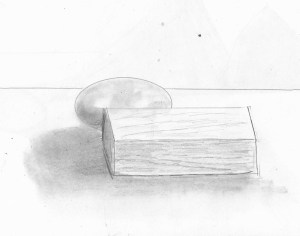
I set out to do the followiing: To create a drawing of two wooden blocks by using technical drawing tools available, to then add basic shading to show lights and shadows, and to complete the drawing by adding a bit of texture.
The smooth egg doesn’t really have a “wood-like” texture, so I focused solely on the wooden block for that part of the drawing process. The egg, in fact, is nearly white, so my shading is off there, too.
Even so, I think this drawing was helpful for me because it does show my new attitude about measuring, sighting, and using technical drawing tools for better accuracy. Even if this drawing isn’t quite proportionally correct, it still represents growth as an artist, a change in my attitude, and a greater understanding of how art can be created.
WHAT DRAWING TOOLS DO YOU USE? DO YOU MAKE USE OF RULERS? TEMPLATES? COMPASSES?
 Artistcoveries
I use no tools. Maybe the odd coffee cup bottom. I should, though.
LikeLike
I’ve used a few old coffee cup bottoms before. Now that I’m realizing how handy tools can be, I’ve bought a nice set of templates. For someone like me (not a natural artist), those tools can be very helpful!
LikeLike
Fair.
LikeLike