This graphite drawing isn’t finished, but I’m sharing it now — at least, in part. What you’re looking at is only a small part of a larger drawing. I’m sharing it today, though, for a number of reasons.
I love landscapes. I enjoy graphite drawing. I want to become a better graphite landscape artist. This has long been one of my art objectives, and while I’ve made progress over the years, I’m still far from satisfied. I look with awe and wonder at graphite landscapes other artists have done, and I wish with all my heart that I had the talent — or, at least, the know-how. It might sound like a strange thing to say, but much of my problem is that I just don’t know how to create the landscape scenes I want to make.
So, I continue looking for instruction; I search out resources; I read, I study, and at present I’m re-reading and reviewing William F. Powell’s book on landscape drawing. The drawing I’m working on now is part of that study.
Previously I shared some of my sketches, illustrations I’d copied from Powell’s book. I also shared the copies I’d made years before. Was there really any improvement? Maybe, but not to a significant degree.
I went on to copy several other illustrations — rocks, this time. I was not at all happy with the results. You’ll notice that I didn’t share them! Not that they were bad. They were “all right”, and that’s where a lot of my drawing frustration comes in. My drawings are all right — not bad, but not really good. I want to do better!
Next, I turned to a section in the book called “Drawing Practice” and attempted to copy the step-by-step instructions for developing any landscape scene. I’ve written about this process before:
In that post I outlined the four steps Powell teaches:
(A) Sketch the basic lines, angles, and shapes you see.
(B) Refine those lines and shapes into the most recognizable objects of the scene.
(C) Add shading to the darkest areas of the scene.
(D) Add details to complete the scene.
Sounds simple enough, right? But the problem — for me — is that while Powell instructs us to do these things, he doesn’t really show us or tell us HOW! But, I tried following along with one of the examples he shared. The results were not good. I closed my sketchbook, turned out the lights, and left the studio feeling a bit disheartened. I will never be a good graphite landscape artist, I lamented.
The next day, I shied away from landscape drawing. I didn’t want to face more failure or discouragement. Instead I spent some time cleaning and re-organizing the studio a bit — a good distraction, you see. And what did I find? In a pile of older sketchbooks, there was my “Graphite Landscape” sketchbook, the one I used while studying Powell’s book several years ago.
Browsing through the drawings, I was surprised to see how good they were — “good” being a relative term, of course. I looked at the rocks I’d drawn and mentally compared them to my most recent attempts. Oh, my rocks were so much better before! I closed the sketchbook and again lamented that I simply will never be a good graphite landscape artist.
After a while, I was tired of cleaning and organizing. I needed to spend a little time drawing, and despite my discouragement — or maybe, in a perverse way, because of my discouragement — I returned to Powell’s book and the “Drawing Practice” section. I did not want to again draw the next scene shown in the book. I’d done that before — you can see the results in the post I linked above — and I knew if I tried again, my drawing would be worse. I couldn’t put myself through that.
So, I opted for another scene. I had no illusions here — and again, this touches upon that question of confidence. It’s said that “we must believe we will succeed“, and frankly, that attitude just does not work for me. If I approach an art project with confidence, I’ll end up failing. It happens every time. Yet when I approach a project with low expectations — if any expectations at all — as often as not I find myself pleasantly surprised by the results.
Needless to say, I was feeling glum as I searched Pixabay for reference photos. I used “wooded landscape” as a search parameter, then browsed through the results and chose one — a scene with a curving pathway and lots of trees.
I knew I could never really draw it, but being in that unhappy, discouraged mood, I set out to prove just how bad an artist I am. I was going to prove, by golly, that those simple A, B, C, D steps of drawing were meaningless. I was going to show William F. Powell just how wrong he was!
Dutifully I sketched out the basic shapes and forms. Oh, what a ridiculous mess of lines I had all over the page! Step by step I attempted to follow along, and the results were almost comical. But I was determined to do my best — just to prove that I couldn’t possibly do it!
I took a good look at my reference photo — a wooded scene with trees along with more trees in the background, a leafy green blur — what? How am I supposed to draw this? I was shaking my head in despair. But, I kept at it.
And something happened. I started blending a bit, thinking about things I’ve learned over the years. I remembered how “art is an illusion”, and I started seeing possibilities in the drawing. So, I slowed down. I changed my attitude a bit. I started looking more closely at what I was trying to do.
I studied the texture on the tree I was working on. I started paying more attention to what I was doing. And I found myself liking the results.
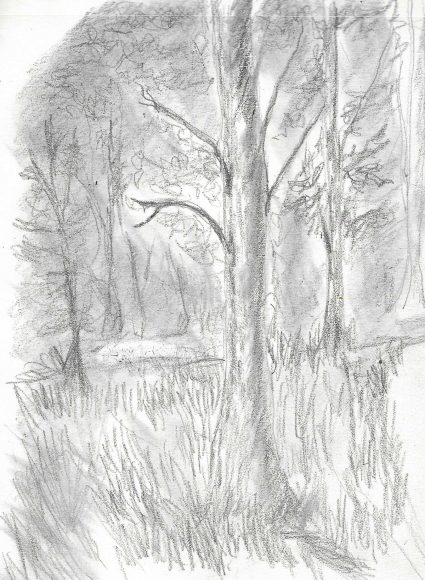
You might look at this small vignette and see only scribbles and messy attempts at landscape drawing. I see something different, though. I see the beginnings of a better understanding about creating illusions in landscape art. I see hope that I might be able to improve my drawing skills. I see a willingness to take my time, a desire to improve, a belief that I can grow as an artist.
What will happen next? I have no idea. As I continue working on this drawing, I might find myself giving up, making a big mess, or just otherwise coming away with one more huge disappointment. But this little piece of the drawing has encouraged me and inspired me. That’s why I’m sharing it today. No matter how the rest of the drawing turns out, I’m excited by this one little section I’ve drawn.
It’s not all I want it to be, but in so many ways, this shows the direction I want to go with my graphite landscape art. Having a direction is an important step, so at long last, I finally feel that I am truly making progress.
 Artistcoveries
I like it a lot. I especially love the stylistic squiggles behind the bare branches. This is another one of those times where, for me as a viewer, the places where your drawings aren’t photorealistic are the most alive, the most whimsical, and the most expressive of meaning. I’d live with this drawing on my living room wall! It would inspire me!
LikeLiked by 1 person
Thanks. What you’re seeing is only part of a larger scene, but I was happy with the “illusions” I was creating.
LikeLiked by 1 person