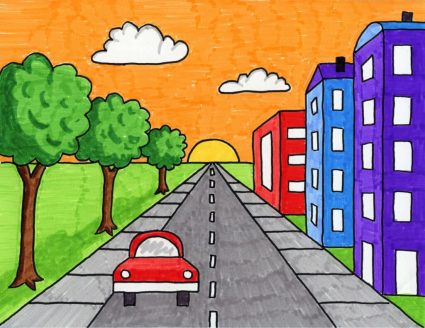
The image you’re looking at is from “Art Projects for Kids“. It is, obviously, from a lesson on perspective. The point here, you see, is that perspective — especially single-point perspective — really is simple, so simple that even a child can do it.
Perspective. Yeah. I’m so frustrated because no matter how many times I go over it, I just can’t successfully follow along with perspective drawing exercises — even ones that should be “child’s play”.
I understand what perspective is. I really do. I understand the concept of single-point perspective and two-point perspective. I can even grasp three-point perspective, although, I’d rather not, thank you very much.
Today my drawing lesson to review was another tutorial on perspective, and yes, I know. Perspective IS important. There’s just no getting away from it. I realize this. If we want our drawings and paintings to have any semblance to reality, we have to understand — and use — perspective.
I’m not good with rulers. Let’s start there, all right? Perspective tutorials invariably involve rulers and drawing lines from corners to vanishing points and then drawing more lines and then erasing lines we don’t really need, and by the time I get to that point I have so many messy lines all over the page that I have no idea which ones are supposed to be there and which ones I can erase, and then trying to erase them just leaves a bigger mess.
Gee, I’m really whining tody, aren’t I! I am sorry. It’s just that perspective has become a real sticking point for me with my art studies. It isn’t that I don’t know what perspective is, why it’s important, and how to use it in art. It’s just that I can’t follow along with “perspective exercises” — most of which involve creating street scenes with rows of buildings with careful attention to the placement of windows and doors.
I’m having to do some serious thinking about the role perspective plays in my art. Right now, of course, I’m playing around in the studio, refreshing my drawing skills, and doing a bit of everything. I’m playing with different media. I’m doing still life drawings, quick landscape sketches, and I’ve even done a few portraits and some gesture drawings. It’s all part of the process of re-acquainting myself with art and feeling at home again here in my art studio.
But when it comes to my art, I know my place. I’m a landscape artist who loves to work with oils and oil pastels. Yes, I have fun dabbling with other media and other genres, but my true love is landscape painting. Perspective is important there, of course, yet it’s not as critical in many ways. My landscape drawings and paintings rarely involve careful, precise measurements for correct perspectives.
So why am I spending hours trying to do perspective exercises? Why am I making myself crazy by trying to complete projects that I just can’t do?
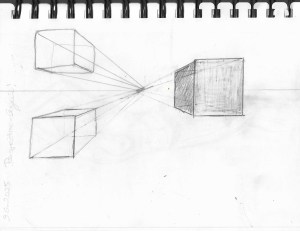
As of today, I’m giving myself permission to skip over any additional lessons and exercises in perspective. I’ve been there, done that, and I do understand the concepts involved. Isn’t that enough?
At some point, we have to accept limitations, and at some point, we have to consider our own preferences, develop our own “comfort zones”, or create our own little “artistic box”. We can talk about getting out of those zones or boxes, and sure, that’s good from time to time, but right now, for me, I think it’s more important that I recognize where I belong — and where I don’t belong.
It’s all right for me to say, you know, I don’t really like painting with acrylics, and soft pastels aren’t really my thing. You know, I don’t really want to do botanical drawing. And, obviously, I don’t ever want to be part of any “urban sketching” group. I don’t want to force myself to do perspective exercises that — in my estimation — aren’t going to greatly impact my landscape art.
The thing is this: I’ve struggled with perspective studies throughout my art journey, not because I don’t understand what perspective is or how to create it. I struggle because I just can’t use rulers and protractors or other measuring implements, and while that may be a very useful skill for some artists, it just doesn’t really seem all that important to me.
I know what perspective is, and I understand how to use it in my landscape art. That’s enough. That’s got to be enough. So, for now, at least, I’m just going to fast-forward past any perspective exercises.
Your thoughts? Should I keep at it and keep practicing perspective exercises even if it makes me crazy? I guess that’s a bit of a loaded question. I would love to hear your thoughts!
And for those who want to brush up on their own perspective skills, you can check out these popular books on the subject:
Creative Perspectives for Artists and Illustrators
The Perspective Drawing Guide: Simple Techniques for Mastering Every Angle
For what it’s worth, I’ve read and studied many of these books. For me, no, perspective drawing wasn’t easy, nor did anyone provide me with “foolproof” techniques. All I can say is that I’ll do my best to use perspective properly — I do understand what it’s all about — and that’s really the best I can do.
 Artistcoveries
The nearest I get to using perspective in my landscape paintings is to paint faraway stuff small in the background and close up stuff big in the foreground – and if I do ever paint buildings at an angle or receding roads I never use a ruler, I much prefer a loose, painterly look that gives a suggestion of distance rather than accurate, precise geometry 🙂
LikeLiked by 1 person
Yep. That’s the approach I take, and it works for me. While I understand perspective, I just don’t have the “technical drawing skills” to be really precise — at least not without giving myself a huge headache. And who wants headaches? Not me. 🙂
LikeLiked by 2 people
I love your landscape work, and it’s always been my feeling that people should go all in on getting really, really good at the things they have natural talent for instead of prioritizing marginal improvement on things they don’t. Yet, if you’re continually drawn to perspective (no pun intended!😀), maybe there’s something there that you intuitively recognize as essential somehow to your growth as an artist, so keep exploring!
LikeLiked by 1 person
I keep “running into” perspective only because I’m reviewing old “how-to-draw” lessons. Perspective is important, of course, but I think it’s more important that we understand the concept than that we can accurately diagram it in exercises LOL. I’m just clumsy with rulers and tools. I get frustrated. It’s not that I don’t know what “perspective” means, and it’s not that I can’t make use of it in my landscapes, as needed. I just can’t follow along with exercises — most of which involve street scenes that I have no interest in drawing! So, yeah, I’ll focus on doing my landscapes and enjoying it, and I’m not going to make myself crazy trying to do “perspective exercises”.
LikeLiked by 1 person
Sounds like a plan!
LikeLiked by 1 person