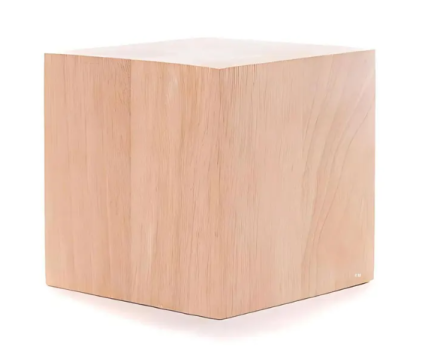
I’m making my way through my 100 days of drawing shapes and forms, and today I pulled out a simple cube. Yes, a cube is a fairly “simple” shape. It’s one we should be able to draw quickly and easily without even needing a reference.
Cubes are important in art. Despite being man-made, or perhaps because of it, we see cubes all around us. I’ll ask you to stop and look around right now. Chances are you’ll see several things that are cubical — perhaps not a perfectly square cube, but definitely a similar form.
Right now I’m looking at several boxes — tissue boxes, small boxes of incense cones, a box of graphite drawing supplies. Boxes are handy to have, aren’t they!
The ability to draw boxes or cubes is especially helpful for those who do urban sketching or architectural drawings. That’s not me! But even in nature, we can see cube-like elements. Large rocks, for instance, can resemble big boxes. And, even landscape artists do occasionally add little features such as barns or sheds that require some knowledge of how to create cubes.
My cube drawings have always been wonky. This was one of the first things my husband commented upon in the earliest days of my drawing lessons. I recall one exercise in which the object was to stack one cube upon another, and mine was so lop-sided it was about to tumble over.
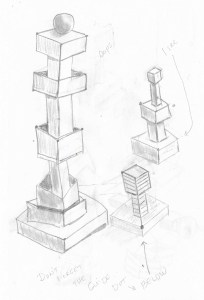
If you were to enlarge this image — although I have no idea why you would want to — you’d see some written notes. “Don’t forget the guide dot”, it says. Sadly, I have completely forgotten the “guide dot”. It came from “You Can Draw in 30 Days” by Mark Kistler, which was the second “how-to-draw” book I bought after making the decision to learn. While I did learn a lot from the book, I was never successful in creating boxes or cubes.
As a child, however, I prided myself on my ability to draw boxes. I remember my mother teaching me this very simple step-by-step process. Here, I’ve very quickly drawn out the four steps involved:

I know, I know. Even that final box is a bit wonky-looking, but if need be, I can use this method to draw a fairly good box. It’s my “fall-back” method when all else fails, and usually, to be honest, every other method I try does fail.
This morning, I did make one attempt at drawing my wooden cube. I looked at it. I studied it. I did my best. It wasn’t good. It was so bad, in fact, that I picked up the block, studied it more closely, and tried again. The second result was better. Finally, on my third try, I came up with a decent-looking cube drawing, but even that is relative. It’s better than my previous attempts, but still a far cry from a well-drawn, geometrically-correct form.
So, I set off in search of more instruction. I would have gone back to Mark Kistler’s book and looked for that “guide dot”, but several years ago I gave that particular book away to a friend who was learning to draw.
I did actually find a helpful video. This is from Circle Line Art School, and it shows two very simple methods for drawing a cube:
Part of the problem, I think, is that cubes can look a bit weird if we look at them too long! Unless our angles are 100% precise, any cube or box we draw can appear a bit odd if we examine them with a critical eye.
I’m not going for absolute perfection, though. I just want the ability to draw reasonably good boxes and cubes. I’ve got my tutorial, I’ve got my wooden block, I’ve got my sketchbook, I’ve got my drawing pencils. I’ve got an eraser, too. I’m all set, and ready to go!
Stick with me, folks! More to come tomorrow!
Do you have any tricks or tips for drawing cubes?
What forms give YOU the most trouble?
 Artistcoveries
Your tower of cubes is quite good! The perspective is really working!
LikeLiked by 1 person
LOL… that was from back in 2015 — the first month I was learning to draw. It reminds me of Jenga. 🙂
LikeLike