Yes, here I am again — briefly. For months now, I’ve been doing everything except art, and that’s all right. I’m enjoying life, dealing with lots of family responsibilities and illnesses, and doing a lot of cleaning and de-cluttering. I do think about art from time to time, and I have done a little dabbling here and there.
I’ve also recently signed up for a free Musea “Drawing Insights” program. It’s not all that much about drawing, really. It’s about using drawing as a technique to connect with our intuition and insights. It’s a method of using drawing as another avenue towards problem-solving.
Now, not that I have any major problems to resolve, or even any little troubles to deal with. Life is good, and as I’ve said above, I’m enjoying it. For me, finding connections between intuition and art are more about gaining a greater understanding of who I am and what I want to do. I’m exploring questions like these:
- Who I am?
- Where do I want to go?
- What do I want to do when I get there?
Musea is an online community that’s devoted to “Intentional Creativity”, and the free program I’m doing — Drawing Insights — has a series of exercises using art to combine heart, head, and hands and create greater awareness. I’ve done a little “intuitive art” before, so it sounded like fun.
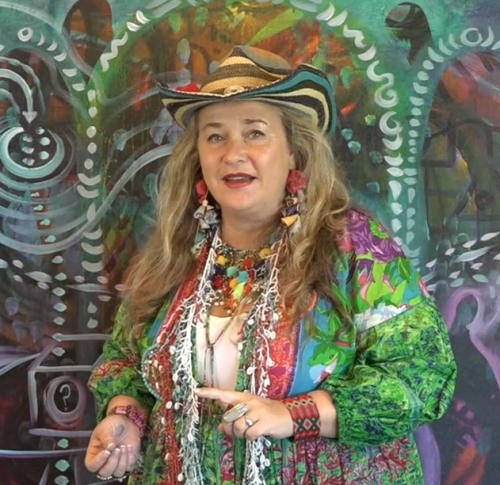
My first drawing exercise was a method called “Metacognitive Drawing”. The instructor, Shiloh Sophia (pictured above), explains first that “metacognitive” simply means “thinking about thinking”, and, therefore, “Metacognitive Drawing” means “thinking about thinking through drawing.”
So, if you want to draw along, grab a large sheet of paper, a pencil, a pen, or whatever! I had a few oil pastels sitting nearby, so that’s what I used.
The principles are these, paraphrased in my own words:
- Choose to do this. Think about what you’re doing and why you want to do it.
- Be intentional. What is the reason you’re doing this? What situation to you want to explore?
- Let go! Release any thoughts of control or expectations.
- Watch your hand as it moves across the page.
- Look for revelations or insights throughout the process.
When I began, I wasn’t at all sure what I was doing or how I was supposed to find “revelations” — but then, as I was finishing up my drawing, a thought came into my head. I felt as though I were creating a lot of jigsaw puzzle pieces. Now, it’s a matter of putting the pieces together. This does “fit well” — a puzzle reference, perhaps — to ideas I’m putting together — another puzzle reference — for future projects.
So, here is my first metacognitive drawing: Putting the Pieces Together
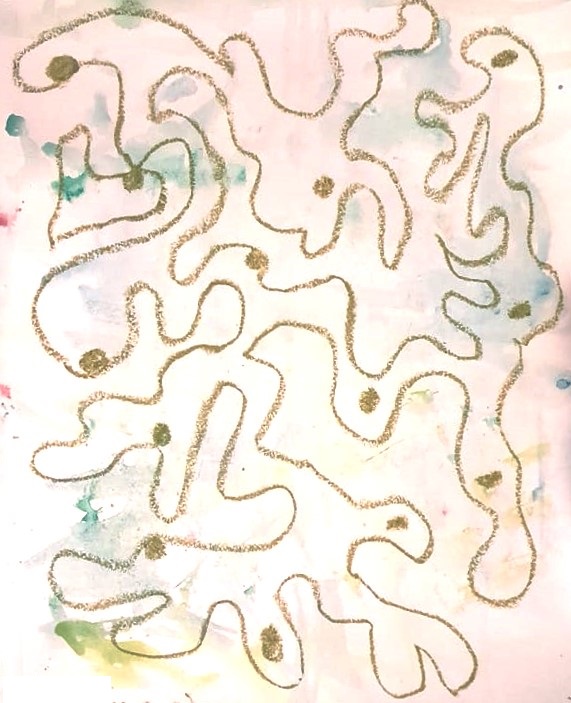
Oh, I should mention that while I was dabbling around recently, I had made a watercolor background, so when I chose to do this metacognitive drawing, I used it.
Now, I can see a lot of things in this, in addition to “puzzle pieces”. I can see tadpoles, birds, friendly ghosts or other monsters, and women’s breasts. Does any of it mean anything? Who knows! It was fun, so I’m sharing it here.
There are several more “drawing insight exercises” in the Musea program, so most likely you’ll be seeing more sqiggly, scribbly drawings in the future. As for my “butterfly” project, no, I have yet to add the final, finishing touches. Maybe someday I’ll do that.
 Artistcoveries
I’d like to see for myself the work of MUSEA on our next road trip to SF area. .Tanks for the idea of intuitive art.
LikeLiked by 1 person
Intuitive art is interesting, that’s for sure!
LikeLiked by 1 person