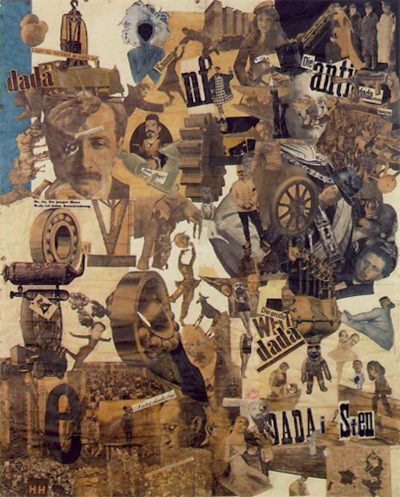
We’ve discussed the Dada art movement before and how it led to the development of Surrealism. The two movements are closely-related, and if you want to look back, you’ll find information here.
To me, the most significant fact to keep in mind is that Dadaism wasn’t confined to art. Here, from Wikipedia, is a concise definition:
Dada or Dadaism was an art movement of the European avant-garde in the early 20th century, with early centers in Zürich, Switzerland, at the Cabaret Voltaire (c. 1916).
The art of the movement spanned visual, literary, and sound media, including collage, sound poetry, cut-up writing, and sculpture.
The Tate Museum offers this definition:
Dada was an art movement formed during the First World War in Zurich in negative reaction to the horrors and folly of the war. The art, poetry and performance produced by dada artists is often satirical and nonsensical in nature.
Personally, I think I’m far more appreciative of “dadaism” in literature and poetry than in visual forms, probably because I’m more comfortable with words than images. It’s easier for me to play with words than with pictures. For me, art is always a bit of a challenge, even when I’m “having fun”, so in some ways the idea of creating truly ridiculous, nonsensical art seems … well, I won’t say wrong, but I will say that it’s hard for me to embrace the idea of using something as precious as artistic talent to create something like Marcel Duchamp’s infamous “fountain” — in reality, simply a urinal.
Sorry, but I can’t bring myself to even post an image of the work, but turning again to the Tate, you’ll find an interesting story about Duchamp’s iconographic work: Fountain – Marcel Duchamp.
You might also enjoy — yet again from the Tate — this podcast: “The Art of Comedy“. It asks if it’s all right to laugh at an art gallery, and goes on to show how artists have used humor in their work.
But, again, what is dada? There are several specific elements we can look for — in both visual arts and in writings.
- Humor
- Whimsy and Nonsense
- Artistic Freedom
- Emotional Reaction
- Irrationalism
- Spontaneity
Yet even while artists sought to find something funny — maybe absurd is a better word — to share with the world, Dadaist art often has significant social and political meaning, so we shouldn’t be too quick to simply laugh it off without considering it at a deeper level.
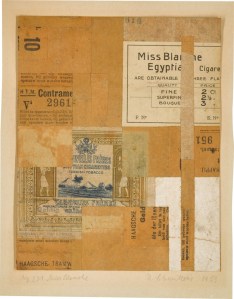 Take this work, as an example. It is Mz231 “Miss Blanche” by Kurt Schwitters, a German artist who created his own collage techniques. He chose to call his works “Merz art”.
Hans Arp, another Dadaist said:
What nectar and ambrosia were to the Greek Gods, glue was to Kurt Schwitters. Schwitters literally feasted on glue, and it was with glue that he produced his marvellous collages.
 Artistcoveries
Dadaism will never be a personal favorite, but learning about the historical and political context has always fascinated me. Thanks for links – the Tate podcast about comedy in art is enlightening….and humorous (especially the analysis of Duchamp’s Fountain). 🙂
LikeLiked by 1 person
My feelings are a lot like yours. While I can appreciate “literary dadaism” to some extent, it’s certainly never going to be something I embrace with visual arts. At the same time, I can understand it better when I put it in context with history. I think too often we see art from our “current” point of view and fail to understand it because it’s so far removed from its proper time and place.
LikeLiked by 1 person
I always have a problem with disjointed art, a.k.a. Dadaism (for one), although I am making an effort to understand the meaning behind the chaos. I do find many artists very clever in putting together images, whether in a collage or a painting. But I am fairly square when it comes to looking outside the box.
LikeLiked by 1 person
I’ve seen some collages that are breath-taking, and I’ve seen some (like Schwitters) that are actually very meaningful. I don’t have “the knack” (or talent, or whatever you want to call it) to do that sort of “dis-jointed” art and make it all come together. I do find the historical, social, and political aspects of different art movements to be very interesting, and Dadaism is no exception there. Mostly I’m learning to see “creativity” in art instead of simply looking for “beauty” like I once did. My understanding has definitely grown a lot.
LikeLiked by 1 person
I think I also suffer from the immediate-gratification-syndrome. I don’t always take the time to figure things out. It’s look at theh colors, the pictures, the shapes, then move on. Perhaps I need to stop and look for the connections more often.
LikeLiked by 1 person
LOL… I can relate. 🙂
LikeLiked by 1 person