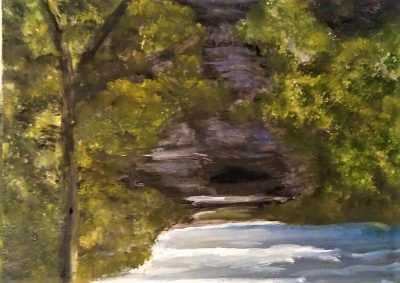
In the coming days I’m going to be focusing more on light and shadow in my oil paintings, and that means I’ll be doing more “quick studies” to try out the tips and tricks I’m learning.
Today’s “assignment” was about beginning a painting with an awareness of where the lights and darks fall. So, I chose a reference photo from my “Inspirations” folder and began by making a computer-generated “notan” study. First, I desaturated the photo. Second, I reduced it to only two values. Here is the result:
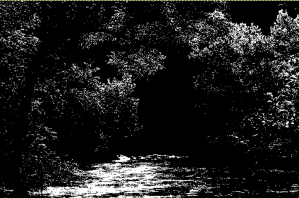
In some respects, this probably wasn’t the best possible reference photo because the various “masses” are not distinct shapes of light and dark. The foliage, as you can tell, has lots of light and lots of dark. I decided to go for it anyway. I liked the dark center — presumably a sort of cave going into the rocks — and I liked the play of the light on the water. I think, too, I was still a bit “under the influence” of Henri Matisse, still thinking of his idea that we should leave room for mystery. I can’t help but wonder what hidden things we might find in that little cave among the rocks.
Here is the painting. I did this on an 8 x 10 panel that I had gessoed with white acrylic. As a study, it was done very quickly. I began by making a “notan” on the canvas, adding black in the areas indicated, and allowing the white gesso to show through. I did allow this to dry a bit before I continued.
Then with that initial black-white study to guide me, I mixed my paints and began applying color.
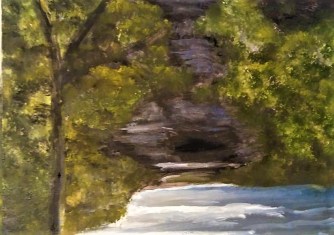
I think I got a lot right, but I missed a bit, too. Mostly, as so often happens, a lot of my lighter values got lost.
To check my work, I uploaded the painting to GIMP, then went through the desaturation and posterization process just as I had done with the original reference photo.
Here was the result:
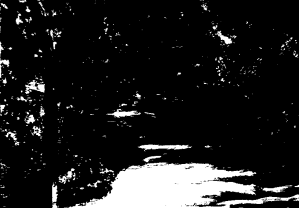
It’s definitely similar to the notan study I began with, and I was pleased that I did get a bit of the “foliage effect” I was going for. Overall, working from the stark black-and-white study was interesting, and I think it did make me more aware of how the light was falling in the scene.
After completing the painting, comparing it to the studies — the original and my own — I can see places where I might want to do a little “tweaking”. I could make the light stronger on the tops of the trees on the right, and I might darken the trunk of the tree on the left. In my painting, I added a bit of light to the trunk. There is no light falling on it when I look at the original notan study. Generally, I ended up with too much light on the left side of the painting. The original black and white image has much more shadow.
This was the first time I’ve used notan as a guide for a landscape painting. One thing I’m working on right now is exaggerating lights and darks so that I will be more aware of them. The black and white format is ideal for that.
The more I look at the painting and make comparisons, the more confident I feel. I did get a lot right, and I can learn from what I got wrong this time around. I’m looking forward to using the notan technique for future paintings. It really is a good tool for learning values.
 Artistcoveries
This looks like a great exercise. I think you did a good job.
LikeLike
Thanks so much. The “notan” exercise was interesting, and helpful, I think.
LikeLiked by 1 person
I’m sure it was Judith. It’s something I do at the end by converting a photo to black and white….the wrong end of things!! 🙄
LikeLiked by 1 person
Doing it at the end certainly helps me see how far off the mark I’ve gone LOL. I know how important values are, so I’m really trying to pay attention to them now. I hope I’m improving a little.
LikeLiked by 1 person
You will be for sure. Practice, practice! 🙂
LikeLiked by 1 person
Oh, yes. Practice. Practice. I love landscape painting. There are so many beautiful scenes all around us.
LikeLike
Tell me about it!! Amazing planet we have here!
LikeLiked by 1 person
Yes, and Earth Day is coming up on April 22! I really hope it will be warm enough that I can get out to the hiking trails with one of my hand-made sketchbooks!
LikeLiked by 1 person
Sounds terrific!
LikeLiked by 1 person
I’m looking forward to it.
LikeLiked by 1 person
Interesting article. Looks like a helpful tool and technique. When you say you uploaded the painting to Gimp, I assume you mean a photo of the painting?
LikeLiked by 1 person
Yes, exactly. I guess I should have explained that better. 🙂
LikeLike
Fascinating! And beautiful! 👏👏👏👏
“Notan” was new to me so I looked it up. Thank you for sharing your process with this piece & for the introduction to the concept. 😁
LikeLiked by 1 person
Notan is an interesting concept to work with. I’m fascinated by Asian art and the “mindset” surrounding the creative process. I even have a “sumi-e” set of inks and brushes but I’m still too intimidated to try learning how to use them. 🙂
LikeLiked by 1 person