
I had fun one evening while my husband worked on painting the walls of my studio. As he rolled paint, I sat here at my computer browsing watercolor videos. Oh, did I find a fun one!
Try These Loose Watercolor Techniques for Backgrounds
Before you get too excited and go clicking away, let me explain first that there’s really only one technique shown — using a spray bottle and dropping wet paint from mixing bowls. It’s fun. I can’t deny that. But I was left scratching my head just a bit. What’s created is supposed to be a background, but how anyone would ever paint anything over a background like this is a mystery. Judging from the comments on the video, I wasn’t the only one asking that question.
But I’m getting a little ahead of myself.
I watched the video, and despite my questions about how to use this as a background, I wanted to play with the technique. My husband had given up painting for the evening, so I happily taped a sheet of watercolor paper to a drawing board and grabbed my spray bottle. I still had a few colors on my palette, so I was ready to play.
My first effort was awful. My sprayer was set to “mist” and the colors I used simply ran together into my all-too-familiar hue of yucky gray. No problem. Reset the nozzle on the spray bottle, grab another sheet of paper and try again.
I came away with an interesting result.
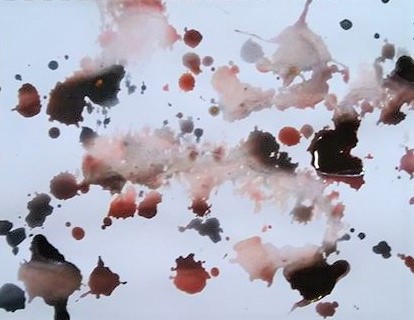
In one place, my paint almost acted the way the paint did in the tutorial, but overall, I actually liked the bright, brilliant splashes of color. Of course, this could never be the background of a painting, so what do I do with it now?
I probably should not mention this, but I’ve taken to calling this painting “The Scene of the Crime” because it really does look a lot like a blood-splattered wall. Yes, yes, I know. My husband and I watch too many of those awful crime shows.
On the other hand, the title fits, because as often as not, when I play with watercolors, it’s tantamount to committing an artistic crime.
By spraying on blobs and globs of water, I had blobs and globs of paint on the paper. It took two days for it to dry completely. Well, actually, even now it’s not completely dry. A few puddled places still have a wet shine.
If you watch the video, you’ll see that my paints and my methods produced markedly different results than what I was trying for. Oh, well. That happens a lot when I play with watercolors.
Overall, in some perverse way, much like I fell in love with Alien Vegetables Flying through Space, I actually find this weird watercolor appealing. Or, maybe not appealing as much as interesting. It’s different. I like it.
But what am I supposed to do with it now?
 Artistcoveries
Just a thought. It kind of looks like dried leaves if you could really give it some shape of leaves.
LikeLiked by 2 people
Interesting thought! I don’t think I’ll try change anything on this original attempt, but you’ve given me ideas for my next attempt! I might try it with “leafy” colors and see what I come up with. Thanks so much for the inspiration!
LikeLiked by 1 person
☺️
LikeLike
It would make a nice book cover for an art journal.
LikeLiked by 2 people
Yes, it would! Several of my “practice pieces” would be good book covers, I think. I might laminate this one and use it as a notebook cover. 🙂
LikeLike
My initial thought was that this was a background technique that cardmakers would use – trim it down to card size and layer a separate focal image over the top – but then I watched the video and she’s actually using it as the starting point for a watercolour painting! I can imagine maybe painting with gouache over it, but more translucent watercolour? Anyway, I much prefer your interesting blood splatter to the dark, muddy mess she created 🙂
LikeLiked by 1 person
LOL… thanks! I’m thinking that maybe if the center were masked off completely before using her techniques, an artist could later create something. I don’t know. It still doesn’t seem very practical as a “background” technique. Even so, it was fun to play with her ideas, and I like my weird splatters, so I guess it’s not a total loss. 🙂
LikeLike